// 2026-08-05 · Data & Research · by Bob Smith
NASA Deep Space Network Now: Watch NASA Talk to Spacecraft Live
DSN Now shows which antennas are contacting which spacecraft right this second, with live signal strength and data rates. Voyager 1 is usually on there.
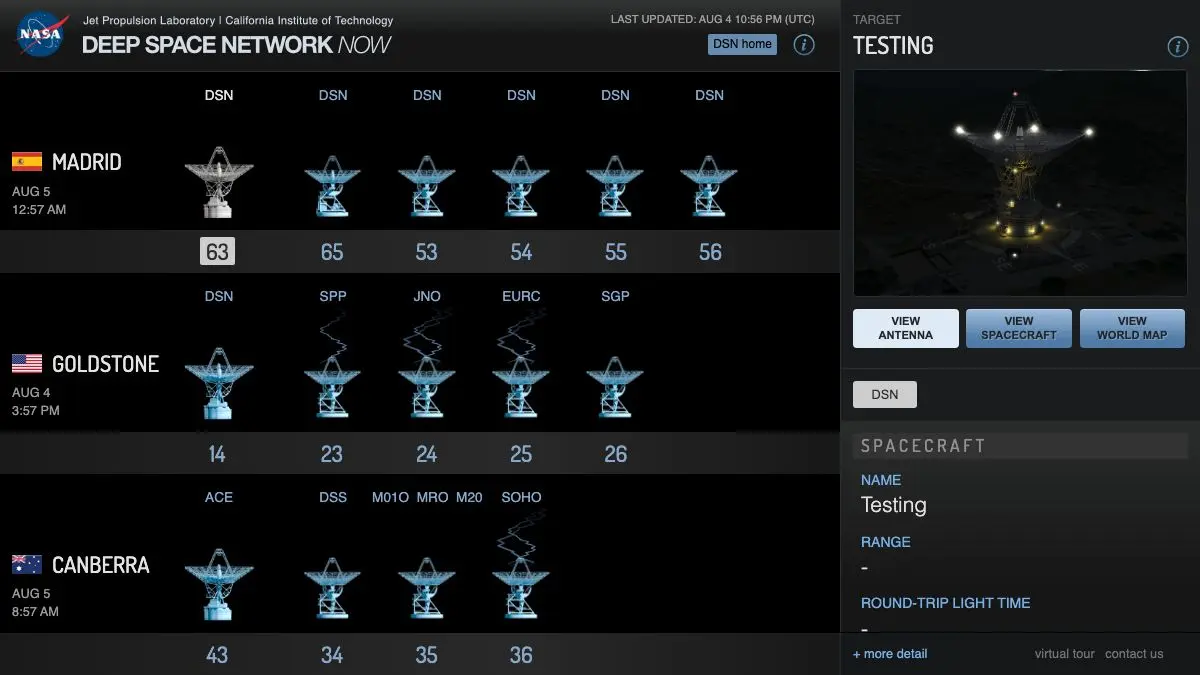
NASA Deep Space Network Now is a live diagram of NASA talking to its spacecraft. Not a simulation, not a recording — right now, at this second, a 70-meter dish in the Mojave Desert is pointed at something enormously far away, and this page tells you what, at what data rate, and how many hours the signal took to arrive.
Open it during a Voyager pass and you are watching a conversation with a spacecraft launched in 1977, currently somewhere past the edge of the heliosphere, at a bitrate slower than a fax machine.
What is DSN Now?
The Deep Space Network is the reason interplanetary missions are possible. Three antenna complexes — Goldstone in California, Madrid in Spain, Canberra in Australia — sit roughly a third of the way around the planet from each other, so that as the Earth spins, one of them can always see whatever is out there. Every command sent to a Mars rover and every image sent back has passed through one of those dishes.
DSN Now, built by JPL, is the public window onto that operation. The interface shows each complex as a cluster of antennas. Antennas actively tracking something are connected by a line to a spacecraft icon, labeled with its mission abbreviation. Click either end and you get the details.
Those details are the good part. Downlink and uplink signal strength in decibel-watts, usually a number like minus 150, which is a way of saying the received power is a fantastically small fraction of a watt. Data rate, which for a nearby orbiter might be megabits and for Voyager is a few dozen bits per second. And round-trip light time — the delay before an answer could possibly arrive — which quietly turns an abstract distance into a lived experience of scale.
It also shows antennas that are idle, or down for maintenance, which is oddly humanizing. The network that reaches to interstellar space still has dishes offline because someone is up a ladder replacing something.
The whole thing is a browser page with no login, and it has quietly become one of the better ambient tabs on the internet. Leave it open on a second monitor and glance at it occasionally to remember that all of this is actually happening.
What can you do with DSN Now?
- See live contacts. Watch which antenna at which complex is currently tracking which spacecraft, updating as passes begin and end.
- Click a spacecraft. Get its full name, distance from Earth, round-trip light time, and the current uplink and downlink rates.
- Click an antenna. See its diameter, frequency band, and what it is doing — tracking, idle, or in maintenance.
- Compare data rates across missions. A Mars orbiter and a deep space probe on the same screen make the inverse-square law extremely tangible.
- Look for Voyager 1 and 2. They still appear during scheduled passes, with light times long enough to be genuinely startling.
- Watch the handoff. Stay long enough and you can see a target drop from one complex and be picked up by the next as the Earth rotates.
- Explore the rest of Eyes on the Solar System. DSN Now is part of a wider JPL suite that includes 3D mission trajectory viewers.
- Build something with the feed. The status data is published in a structured format, and people have wired it into desk displays and Raspberry Pi dashboards.
Tips to get the most out of it
Check the round-trip light time first. It is the single most affecting number on the page. Seeing a value of many hours next to a spacecraft that a human being built and launched does more for your sense of scale than any diagram of the solar system.
Come back at different times of day. Which complex is busy depends on where the Earth has rotated to. A visit in the morning and a visit at midnight show you completely different halves of the network.
Note the tiny data rates. A few tens of bits per second is a working link to interstellar space. That number puts every complaint about home broadband into perspective permanently.
Look up the mission abbreviations. The labels are terse — a three or four letter code. Searching one usually opens a rabbit hole into a mission you had never heard of that has been quietly working for a decade.
Do not panic when a spacecraft is missing. Contacts are scheduled in blocks, not maintained continuously. Absence from the display means nobody is tracking it right now, not that anything is wrong.
Use it as an ambient tab, not a destination. The pleasure is cumulative. Glancing at it once a day for a week tells you more about how the network breathes than an hour of staring.
If you like NASA Deep Space Network Now, also try…
- How Many People Are In Space Right Now: the simplest possible live space dashboard, and strangely moving.
- 100,000 Stars: an interactive map of our stellar neighborhood that keeps zooming out past comfort.
- Flightradar24: the same live-tracking pleasure, applied to aircraft in the atmosphere below.
- If the Moon Were Only 1 Pixel: a to-scale solar system that makes you scroll for the emptiness.
More live numbers worth staring at in Data & Research, and more sky in Maps & Exploration.
Frequently asked questions
What is NASA Deep Space Network Now?
DSN Now is a live web visualization of NASA's Deep Space Network, the array of giant radio antennas that communicates with spacecraft beyond Earth orbit. It shows which antenna is pointed at which spacecraft at the current moment, along with signal strength, data rate and round-trip light time. It is published by NASA's Jet Propulsion Laboratory as part of the Eyes on the Solar System family of tools.
Is DSN Now free?
Yes. It is a free public NASA tool that runs in a browser with no account or plugin. The underlying status data is also published in a machine-readable feed that hobbyists have used to build their own dashboards and status displays.
Where are the Deep Space Network antennas?
There are three complexes spaced roughly 120 degrees apart in longitude — near Goldstone in California, near Madrid in Spain, and near Canberra in Australia. The spacing means at least one site can see almost any deep space target as the Earth rotates, so contact is never lost simply because a mission set below the horizon.
Can I see Voyager on DSN Now?
Often, yes. Both Voyager spacecraft still make scheduled passes and appear on the display when an antenna is tracking them, with a round-trip light time measured in many hours. Contacts are scheduled rather than continuous, so if a spacecraft you want is not shown, it simply is not being tracked at that moment.
Visit NASA Deep Space Network Now →
← All posts · Browse the directory