// 2026-06-21 · Maps & Exploration · by Bob Smith
If the Moon Were Only 1 Pixel: Scroll the Solar System
If the Moon Were Only 1 Pixel is a true-to-scale map of the solar system you scroll through. Space is mostly nothing, and this proves it. Free and brilliant.
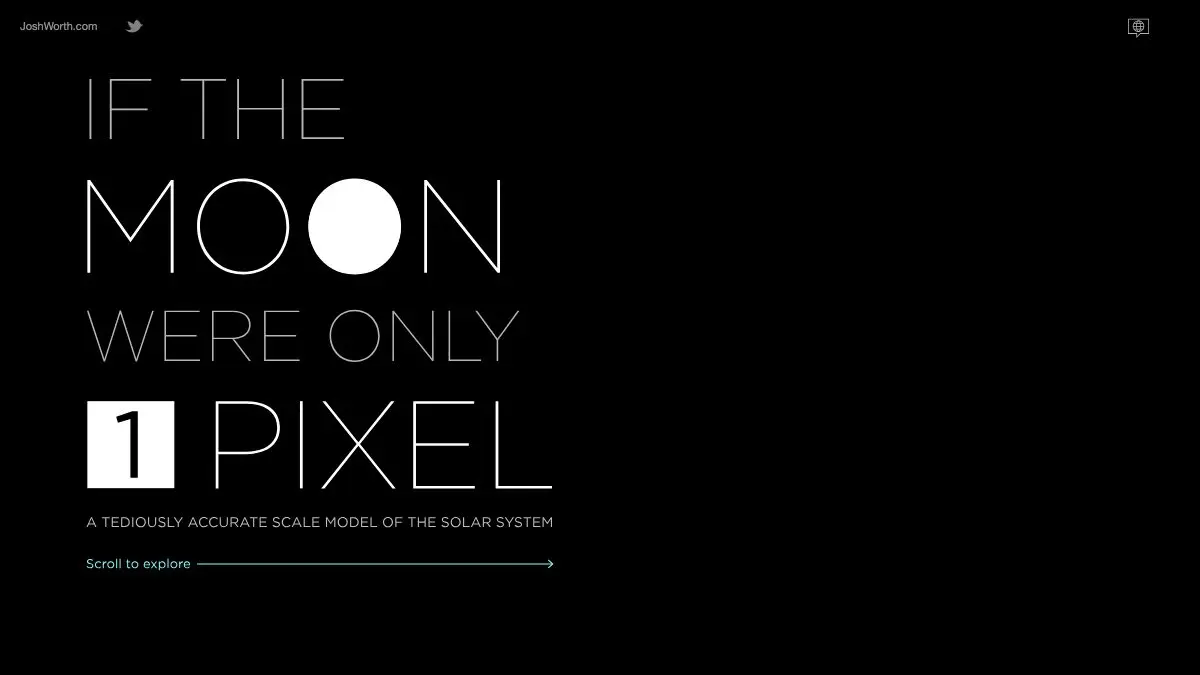
If the Moon Were Only 1 Pixel is a map of the solar system that refuses to lie. Shrink the Moon down to a single pixel, keep every other distance in proportion, and scroll sideways from the Sun. What you get is a very small number of planets separated by an absolutely staggering amount of nothing. It is free, it is one page, and it will permanently ruin every textbook diagram you have ever seen.
What is If the Moon Were Only 1 Pixel?
Every solar system poster you saw as a kid was a lie of convenience. To fit nine bodies onto one sheet of paper, the artist has to squash the distances until the planets look like a neat little row of marbles. Everyone knows this is a simplification. Almost nobody has felt what the real version is like.
Josh Worth built the honest version. One pixel equals the diameter of the Moon, and from there every planet size and every orbital distance is scaled correctly on one enormous horizontal page. That is the entire concept, and it is devastating.
You start at the Sun, which is satisfyingly large. Then you scroll. And scroll. Mercury shows up eventually, a speck. Then more nothing. Venus. Nothing. Earth, so small you might scroll past it. Then a lot of nothing, and Mars, and then a stretch of emptiness so long you will genuinely wonder whether the page has broken.
It has not broken. That is just what space is.
To keep you sane, Worth scattered small captions across the void, dry, funny, occasionally philosophical notes that appear in the middle of the emptiness like roadside signs on a desert highway. They are the reason the page is beloved rather than merely educational.
What can you do on this page?
- Scroll right. That is it. No menus, no settings, no tutorial. The interaction is one gesture and it never changes.
- Read the captions in the void. They are the reward for persistence, and several of them are the best writing on any science page on the internet.
- Try the light-speed option. The page lets you travel at the speed of light. It is still slow. This is the moment the scale actually lands.
- Jump to a planet. There are shortcuts to skip ahead if you need to get to the outer solar system without aging visibly.
- Compare the planets honestly. Seeing Jupiter next to Earth at true relative size is a different experience from seeing it on a poster.
Tips to get the most out of it
Do the first stretch manually. Do not jump straight to a shortcut. Scroll from the Sun to Mercury with your own hand so your body learns what the distance costs. Everything after that means more.
Use a mouse with a real scroll wheel, or a trackpad with momentum. Dragging a scrollbar is efficient and emotionally useless. You want the sensation of covering ground.
Then use the light-speed button anyway. The one-two punch of “this is slow by hand” followed by “this is slow at the fastest speed physics allows” is the whole thesis, delivered in about a minute.
Read every caption, even the throwaway ones. People remember this page for the jokes in the emptiness as much as for the astronomy. Skipping them turns a great page into a merely correct one.
Do it on desktop. It works on a phone, but a wide screen makes the emptiness feel wider, and width is the entire medium here.
Show it to someone who thinks space is crowded. Which is most people, because most people learned from posters. This takes ninety seconds to change their mind.
If you like If the Moon Were Only 1 Pixel, also try…
- Scale of the Universe: the same honesty applied to size rather than distance, from subatomic to cosmic on one slider.
- The True Size Of: drag countries across a world map and discover how much the Mercator projection has been lying to you.
- Zoomquilt: an endlessly zooming painting for when you want the vertigo without the homework.
More mind-stretching maps live in our Maps & Exploration collection. Then go open If the Moon Were Only 1 Pixel and start scrolling. Clear your afternoon. Or at least your next ten minutes.
Frequently asked questions
What is If the Moon Were Only 1 Pixel?
It is a single web page by designer Josh Worth that maps the solar system at true scale, using the Moon shrunk to one pixel as the unit of measurement. You scroll sideways from the Sun outward, and because nothing is exaggerated, you spend most of the journey looking at empty black space. It is widely considered one of the clearest demonstrations of how vast the solar system actually is.
Is If the Moon Were Only 1 Pixel free?
Yes. It is a free web page with no account, no app and no cost, and it works in any modern browser on desktop or mobile. There is nothing to install and nothing to sign up for.
How long does it take to scroll the whole thing?
Scrolling manually from the Sun to the outer solar system takes a long and deliberately tedious few minutes, which is the entire point. The page includes a light-speed shortcut so you can watch how long even light takes to cross the same distance, and that comparison is usually more shocking than the scrolling.
Why is so much of the page empty?
Because the solar system is empty. Most diagrams shrink the distances so all the planets fit on one page, which quietly teaches everyone that space is crowded. This page refuses to cheat, so the gaps between planets stay in proportion and the emptiness becomes the main character.
Visit If the Moon Were Only 1 Pixel →
← All posts · Browse the directory