// 2026-06-20 · Learning & Education · by Bob Smith
Scale of the Universe: One Scrollbar, Everything
Scale of the Universe zooms you from quantum foam to the observable universe on a single slider. Click anything to learn what it is. Free, and overwhelming.
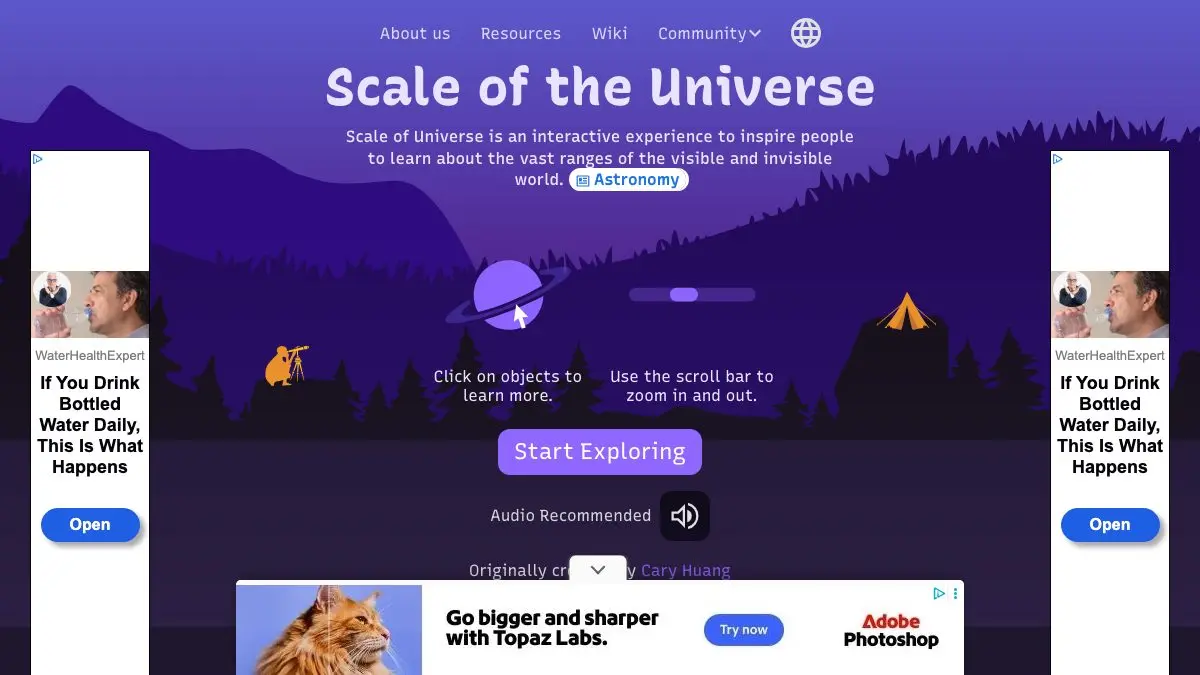
Scale of the Universe is a single slider that contains everything. Drag it left and you fall through cells, viruses, atoms and down toward the smallest scales physics can describe. Drag it right and you rise past whales, mountains, planets, galaxies and out to the edge of the observable universe. Click anything you pass to find out what it is. It is free, it takes ten seconds to understand, and it is genuinely hard to stop.
What is Scale of the Universe?
Numbers are terrible at conveying size. “Ten to the minus nine meters” is a fact you can memorize and never once feel.
Scale of the Universe fixes that by refusing to break the zoom. Everything sits on one unbroken axis, so you cannot skip from the microscopic to the cosmic, you have to travel through it, watching each object shrink into a dot while the next one swells up behind it. That continuity is the whole idea. The emptiness between an atom and a grain of sand is not described to you, it is scrolled through.
The project began as a Flash piece by Cary Huang, a teenager at the time, and became one of those internet objects everyone’s science teacher eventually showed them. It has since been rebuilt for the modern web by a small team, so it runs in any browser now, with sound and a much smoother ride.
The best moment is not the largest thing or the smallest thing. It is the middle, the stretch where you realize how much of the range you personally live in, and how narrow it is.
What can you do on Scale of the Universe?
- Drag the slider. That is the interface. Left for smaller, right for larger. On desktop you can also just scroll.
- Click objects for the story. Every item opens a panel with what it is and how big. This is where it stops being a toy and turns into an education.
- Turn the sound on. The site recommends it, and it is right. The audio shifts as you change scale and does an enormous amount of emotional work.
- Hunt for the familiar. Finding a human, a blue whale, Mount Everest or your city on the same continuum as a proton is the whole joy.
- Go to the ends. Push all the way down, then all the way up. Both extremes are worth the trip, and the return journey is even better.
Tips to get the most out of it
Go slow through the tiny end. Most people blast down to the smallest scale in five seconds and miss everything. The stretch from a cell to an atom is packed with objects you have heard of your whole life and never placed relative to each other.
Pick one object and travel from it. Start at a human and count how far you have to drag before you reach a bacterium, then how far to a galaxy. The asymmetry is the lesson.
Full screen, big monitor, sound on. This is not a phone-in-a-queue site. It is a sit-down-and-look site, and the difference is enormous.
Read the panels for the things you think you know. Everyone knows what a red blood cell is. Almost nobody knows how it stacks against a wavelength of visible light. The comparisons are the payoff.
Use it as an argument settler. Any time a conversation stalls on “how big is that really,” this is the fastest way to end it, with visuals.
Follow it with a related trip. Scale of the Universe covers everything but flattens distance. Pair it with a solar-system walk to feel the other half of the problem.
If you like Scale of the Universe, also try…
- If the Moon Were Only 1 Pixel: the perfect companion: same true-scale honesty, applied to the terrifying emptiness between planets.
- Zoomquilt: an infinite painting that zooms forever into itself, for when you want the sensation without the science.
- Bartosz Ciechanowski: deep interactive explainers on how physical things actually work, and the best follow-up when the panels leave you wanting more.
- Neal.fun: a whole playground of interactive scale and scope experiments, several of which will eat your evening.
Find more brain-rearranging sites in our Learning & Education collection, then go drag the slider on Scale of the Universe. Start small.
Frequently asked questions
What is Scale of the Universe?
Scale of the Universe is an interactive web experience that puts every size of thing on one continuous zoom, from the smallest scales physics describes up to the observable universe. You drag a single slider and objects glide past in order of size, and clicking any of them opens a short explanation. It was originally created by Cary Huang and has since been remastered by a small team.
Is Scale of the Universe free?
Yes, Scale of the Universe runs free in a browser with nothing to install and no account required. It works on desktop and mobile, though the sense of scale lands hardest on a big screen with sound turned on.
How do you use Scale of the Universe?
Click Start Exploring, then drag the zoom slider left to go smaller and right to go larger. On a desktop you can also scroll to zoom. Clicking any object on screen opens an information panel telling you what it is and how big it is, so you can move between browsing and reading at your own pace.
Is Scale of the Universe good for kids and classrooms?
It is one of the best free tools for teaching scale, because it makes orders of magnitude something you feel rather than something you read. Kids can drive it themselves within seconds, and the short object descriptions give a teacher plenty of jumping-off points for questions about biology, chemistry and astronomy.