// 2026-08-05 · Learning & Education · by Bob Smith
Littler Books: Nonfiction Summaries That Get Straight to the Point
Littler Books condenses well-known nonfiction titles into sharp bullet-point summaries you can read in about twelve minutes, with free web versions and PDFs.
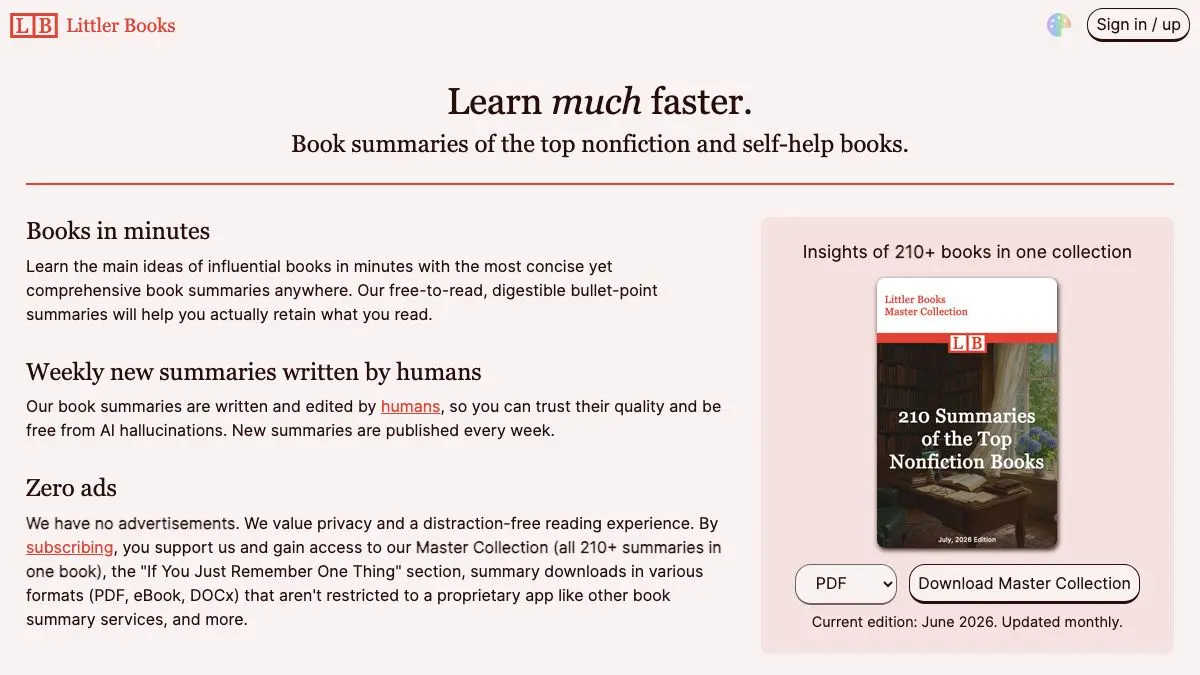
Littler Books takes a 300-page nonfiction book and reduces it to a numbered list you can read on a train ride. That sounds like a crime against literature until you remember how many business and self-improvement books are one decent idea wearing a trench coat, padded out with anecdotes to justify the hardcover price.
What is Littler Books?
The nonfiction publishing industry has a structural problem: the minimum viable length of a book is far longer than the minimum viable length of an argument. An idea that fits in a long essay gets stretched to fill 280 pages because that is what a book has to weigh to be sold as a book.
Littler Books is one response to that. It publishes condensed versions of well-known nonfiction titles, mostly in business, psychology, productivity, habits, finance and popular science. Each summary reduces the book to its core claims, presented as a sequence of short numbered takeaways rather than a continuous essay.
The format is the point. There is no attempt to preserve the author’s voice or reproduce the narrative arc, because that is what the actual book is for. What you get instead is the argument’s load-bearing structure, which is often surprisingly compact.
Summaries are readable on the site, downloadable as PDFs, and available through a mobile app with a paid tier for people who want the whole library in their pocket. The catalog covers a lot of the titles that dominate airport bookshops and management reading lists, which is exactly the corner of publishing where summaries are most useful.
The honest use case is triage. You have forty books on a list you will never finish. Read the twelve-minute version of ten of them, find the two that actually deserve your evenings, and let the other eight go.
What can you do with Littler Books?
- Read a full summary for free. Open any title on the site and the condensed version is right there, no account required to start reading.
- Download PDFs. Many summaries can be saved as PDFs, which makes them easy to file, annotate or read offline.
- Browse by category. The library is sorted into areas like business, psychology, health, and personal finance, so you can graze a whole subject instead of hunting individual titles.
- Use the app. A mobile version puts the library on your phone, with a paid tier for offline reading and additional features.
- Refresh a book you already read. Reading the summary of something you finished two years ago is a fast way to recover the parts you actually retained, and notice the parts you did not.
- Screen your reading list. Run a candidate book through the summary first and decide whether the full version is worth the time.
Tips to get the most out of it
Treat it as a filter, not a substitute. The best books on the list get better when you read them properly. The summary is how you find out which ones those are.
Read the takeaways out of order. Because summaries are structured as discrete points rather than a narrative, you can skim the list, stop at whatever looks interesting, and skip the rest without ending up confused.
Save the PDFs of the books you care about. A folder of summaries becomes a genuinely useful personal reference: you can search it later for the half-remembered idea whose source you have forgotten.
Notice when a book summarizes badly. If reducing a book to twelve minutes loses almost nothing, that tells you something about the book. If the summary feels thin and unsatisfying, that usually means the value is in the storytelling and evidence, and you should read the real thing.
Pair it with the actual text. Read the summary first, then the book, and you will read the book faster because you already know where it is going. It is the same trick as reading the abstract before the paper.
Do not confuse recognition with knowledge. Skimming forty summaries produces a pleasant feeling of being well-read that does not survive contact with anyone who has read the books. Use it deliberately.
If you like Littler Books, also try…
- Open Library: borrow the full text of the book once the summary convinces you it is worth reading.
- Project Gutenberg: tens of thousands of public domain books, complete and free.
- Global Grey eBooks: beautifully formatted free ebooks of classic and out-of-copyright titles.
- Whichbook: find your next read by mood and tone instead of by bestseller list.
More ways to learn faster in Learning & Education, and more things that save you time in Productivity.
Frequently asked questions
What is Littler Books?
Littler Books is a site that publishes short summaries of popular nonfiction books. Each summary strips a full-length title down to its central argument and key takeaways, written as numbered points rather than flowing prose, so a book takes roughly ten to fifteen minutes to get through. The catalog leans heavily toward business, psychology, self-improvement and popular science.
Is Littler Books free?
You can read summaries on the site for free, and many are available as downloadable PDFs. There is also a mobile app and a paid tier that unlocks extra features and offline access. The free web version is enough for most people who just want to skim a book before deciding whether to buy it.
Are book summaries a replacement for reading the book?
No, and Littler Books does not really pretend otherwise. Summaries give you the skeleton of an argument without the stories, evidence and voice that make a good book worth reading. They work best as a filter for deciding what to read properly, or as a refresher for something you finished years ago.
How long is a Littler Books summary?
Most summaries run to a few pages and take around ten to fifteen minutes to read. They are structured as discrete numbered takeaways, so you can skim the list, stop at anything that interests you, and abandon the rest without losing the thread.