// 2026-05-09 · Learning & Education · by Bob Smith
Project Gutenberg: 75,000 Free Ebooks, No Account Needed
Project Gutenberg hosts 75,000+ public-domain ebooks you can download instantly in EPUB, Kindle, HTML or plain text. No sign-up, no DRM, no cost.
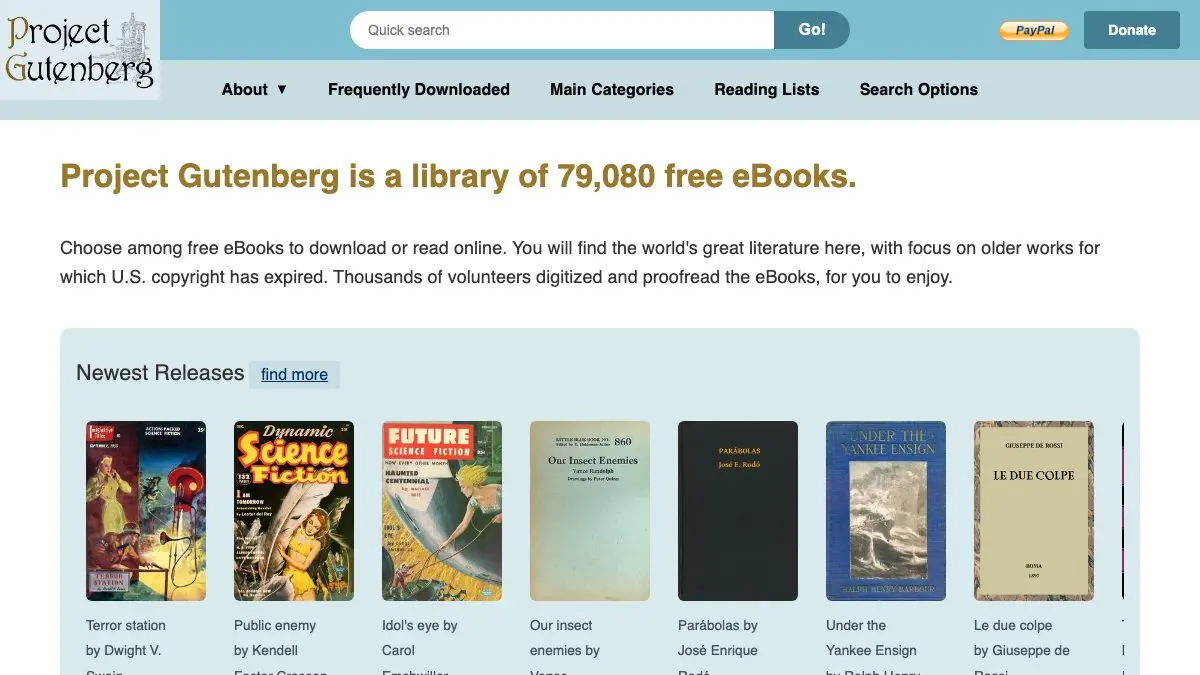
Project Gutenberg is a free library of more than 75,000 ebooks. Public domain, no DRM, no account, no email address, no “start your free trial.” You click a title, choose a format, and the book is on your device in about four seconds.
It is the oldest digital library on the internet, started in 1971, before the web existed, and it still does the job better than most modern bookstores.
What is Project Gutenberg?
The founding act was a volunteer typing out the US Declaration of Independence and putting it on a network so anyone could have a copy. That was the whole idea, and fifty-odd years later the idea has scaled to tens of thousands of titles, digitized and proofread by volunteers.
The collection is mostly work whose copyright has expired, which means it skews toward pre-1930s publishing. That sounds like a limitation until you look at what’s actually in there: Austen, Dickens, Dostoevsky, Twain, Shelley, Conan Doyle, Wilde, Melville, the Brontës, Verne, Kafka, most of the Greek and Roman canon, and then a vast strange hinterland of Victorian travel writing, obsolete engineering manuals, forgotten adventure serials and cookbooks that call for a quantity of lard you will find alarming.
The site itself is plain, search box, categories, book pages. That plainness is a feature. There is nothing between you and the download.
What can you do on Project Gutenberg?
- Download in any format you like: EPUB for e-readers and phone apps, HTML for reading in the browser, plain UTF-8 text for maximum portability, and Kindle-friendly options for many titles.
- Read straight in the browser without downloading anything at all.
- Browse by bookshelf: curated topical collections that are far more interesting than the search box for aimless browsing.
- Search by language: the collection spans many languages beyond English.
- Grab an entire author’s works in one sitting, since there’s no per-book cost or borrowing limit.
- Use the texts freely: quote them, remix them, feed them to a project. Public domain means public domain.
- Volunteer: the proofreading effort that turns scans into clean text is open to anyone with spare time and an eye for typos.
Tips to get the most out of it
Use the Bookshelves, not just search. Search is for when you know what you want. Bookshelves are for discovering that there are forty volumes of Antarctic exploration diaries and you now need to read one.
Download EPUB, not text, for actual reading. The plain text files are wonderful for processing and awful for reading, no chapter breaks, no formatting. EPUB gives you a proper book in whatever reader you use.
Sort by popularity when you’re stuck. The “top downloads” list is a genuinely good reading list, and it exposes the odd titles that are quietly beloved rather than just famous.
Pair it with audiobooks. Because these texts are public domain, volunteer-recorded free audiobooks exist for a huge number of them. Same book, two formats, both free.
Check for multiple editions. Popular works often have several uploads with different translations or annotations. For anything translated, Homer, Tolstoy, Dante, the translation choice matters more than anything else about the file.
Load up before a flight. No account, no license check, no online activation. Download thirty books in ten minutes and they’re yours forever, offline, on every device you own.
If you like Project Gutenberg, also try…
- Open Library: the borrowing counterpart, with millions of in-copyright books lendable in the browser.
- Internet Archive: the wider nonprofit archive behind Open Library, with scanned texts, films, software and the Wayback Machine.
- TypeLit.io: practise touch typing by retyping entire classic novels. Guess where the novels come from.
- Artvee: the visual equivalent: thousands of high-resolution public-domain paintings and posters, free to download.
More in Learning & Education.
Go to Project Gutenberg, download the book you were supposed to read at sixteen, and actually read it this time. It costs nothing but the evening.
Frequently asked questions
What is Project Gutenberg?
Project Gutenberg is a volunteer-run digital library of over 75,000 free ebooks, mostly works whose copyright has expired. Every book can be read online or downloaded in common formats like EPUB, HTML and plain text, with no account and no DRM. It is the oldest digital library on the internet, started in 1971.
Is Project Gutenberg free and legal?
Yes on both counts. The books are in the public domain in the United States, which is why they can be given away freely, and the site is run by a nonprofit on donations. You can download, read, copy and reuse the texts without paying anyone.
What formats can I download from Project Gutenberg?
Most titles are available as EPUB, HTML for reading in a browser, and plain UTF-8 text, with Kindle-compatible options for many books too. Some also include original scanned images or alternative editions, and there is no limit on how many you download.
What books are on Project Gutenberg?
Mostly pre-1930s literature, philosophy, history and science, the classics you were assigned at school plus enormous amounts of forgotten popular fiction, travel writing, cookbooks and technical manuals. Titles from many languages are included alongside the English collection.