// 2026-08-05 · Learning & Education · by Bob Smith
Literature Map: A Constellation of Authors You Might Actually Like
Type any author into Literature Map and it draws a cloud of writers whose readers overlap with theirs. The closer the name, the likelier the match. Free, instant, no account.
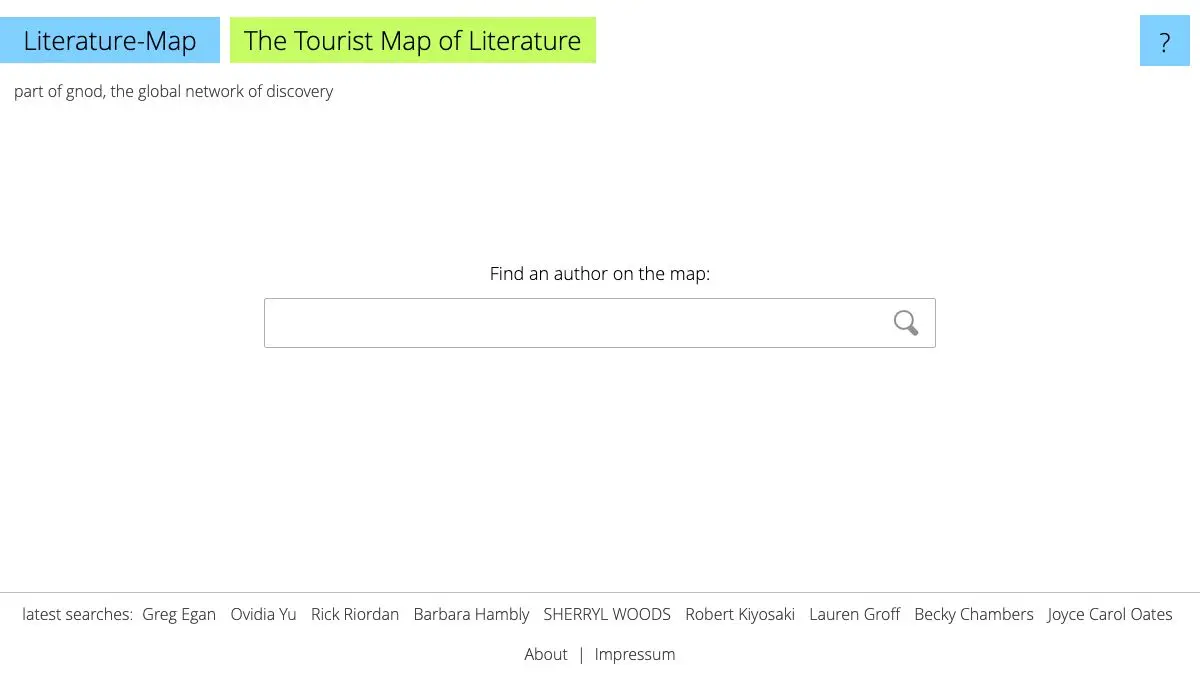
Literature Map does one thing. You type an author’s name, and it draws a cloud of other authors around it, with distance standing in for similarity. Names near the center are the strong matches. Names drifting out at the edges are the maybes. There is no login, no algorithmic feed, no “readers also bought”, and no attempt to sell you anything. It calls itself the tourist map of literature, which is exactly right.
What is Literature Map?
It is part of Gnod, the Global Network of Discovery, a set of recommendation experiments that has been quietly running since the early 2000s. The best-known sibling is Music-Map, which does the same trick for bands. Literature Map is its bookish twin, and both are fed by the same basic mechanism: people tell the system which things they like, and over time the co-occurrence of those preferences pulls related names toward each other.
That approach produces recommendations with a very different character from what a retailer gives you. A store recommends the book most likely to be bought next, which means recent titles, same genre, same publisher push. Literature Map recommends the author most likely to be loved by the same person, which is a stranger and more interesting question. Search for Borges and you get plenty of names that no marketing category would ever put on a shelf beside him.
It also does not care about time. Living authors and long-dead ones sit in the same cloud, weighted only by reader overlap. A contemporary novelist can land right next to someone who died in 1890, because the people who love one keep turning out to love the other.
The interface is defiantly of its era. Plain text names on a plain background, animating into place, with a list of other people’s recent searches at the bottom of the homepage. That last detail is unexpectedly charming: a running ticker of what strangers are currently curious about, which is its own recommendation engine if you let it be.
The honest caveat is that it is only as good as its data. Very famous authors have dense, reliable maps. Obscure ones may return sparse clouds or nothing at all, and the associations sometimes reflect what was popular when the data was gathered. Treat it as a lead generator, not an oracle.
What can you do with Literature Map?
- Search any author. One box, one name, instant map. There is nothing else to configure.
- Read the distances. Proximity is the whole interface. Close means strong overlap, far means tenuous.
- Click any name to re-center. Every author on the map is a link, so you can walk from writer to writer indefinitely.
- Cross-check two authors. Map one, then map the other, and the names appearing in both clouds are unusually promising.
- Browse the latest searches. The homepage lists what other people are currently looking up, which is a decent random-discovery button.
- Use Music-Map for the same trick with bands. Same engine, same layout, entirely different library.
Tips to get the most out of it
Search an author you love, not one you merely finished. The map answers “who else do your people read”, so it only works if the starting point genuinely represents your taste.
Take the middle distance, not the nearest names. The closest results are usually authors you already know, because obvious neighbors are obvious. The good discoveries sit one ring out, close enough to be relevant and far enough to be new.
Triangulate with a second search. Map two favorites and look for the names that appear on both. That intersection is far more reliable than any single map’s top result.
Click through instead of retyping. Walking the graph, three or four hops from where you started, gets you somewhere a single search never will.
Expect gaps at the edges of the catalog. Genre specialists, poets in translation and recent debuts are thinly covered. A blank map means missing data, not a verdict on the author.
Write the names down somewhere. There is no account and no saved history, which is part of the appeal and also means a good map disappears the moment you close the tab.
If you like Literature Map, also try…
- Music-Map: the same spatial similarity cloud, built for bands and musicians.
- Gnoosic: the other half of the Gnod project, which recommends music by asking you three questions.
- TasteDive: cross-medium recommendations that jump from a book to a film to a show.
- Whichbook: choose your next read by mood, tone and setting rather than by author.
More ways to find the next good thing in Learning & Education, and the rest of the recommendation machinery in Entertainment & Fun.
Frequently asked questions
What is Literature Map?
Literature Map is a book recommendation tool that shows author similarity as a spatial cloud. You enter one writer's name and the site draws other authors around it, positioning each one by how strongly their readership overlaps with the author you searched. It is part of Gnod, a family of discovery sites that includes Music-Map.
Is Literature Map free?
Yes. It is free to use, requires no account and asks for no personal information. It has been running in more or less its current form for many years and is deliberately minimal.
How does Literature Map decide which authors are similar?
It is built on aggregated reader preferences rather than analysis of the text itself. When enough people indicate that they enjoy two authors, those authors drift closer together on the map. That means it reflects who tends to read whom, which often cuts across genre and period in useful ways.
Why do the author names move around?
The layout is computed live, so names animate into position as the map settles rather than appearing pre-arranged. Once it stops moving, distance is the signal: names near your search term are the strongest matches and names at the edges are looser associations.