// 2026-08-05 · Entertainment & Fun · by Bob Smith
TasteDive: Recommendations That Cross Between Media
TasteDive takes a band, film, book or game you like and suggests similar things across every category, including ones you did not ask about.
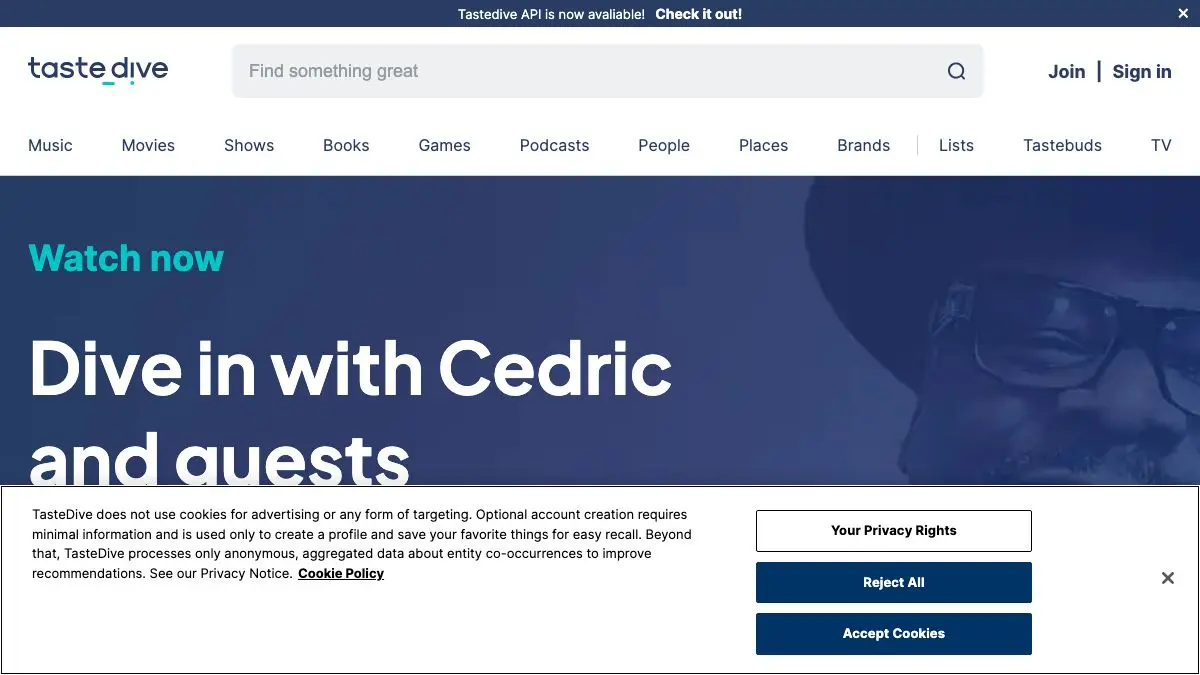
TasteDive does one thing and does it without ceremony: you tell it something you like, and it tells you what else you will probably like. The useful part is that it does not care what category you started in. Type a band and it will happily suggest a novel.
There is a search box, a set of results, and no attempt to keep you on the site. It feels like a tool from an earlier and better-mannered internet, which is roughly what it is.
What is TasteDive?
It launched as TasteKid and rebranded to TasteDive later, but the premise has never moved. Enter one or more things you like. Get back a list of similar things, each with a one-line explanation of what it is. Click any result to pivot and search from there instead.
The cross-media capability is the reason to use it over anything else. Every streaming service, storefront and library has some form of “more like this,” and every one of them is locked inside its own catalog. Spotify will never recommend you a novel. Goodreads has no opinion about your favorite director. TasteDive treats music, film, television, books, authors, games and podcasts as one connected space, because in the heads of actual people they are one connected space.
The mechanism is association rather than classification. It works from what people who like one thing also tend to like, which produces suggestions that a genre-tag system could never generate. This is why the results occasionally look wrong and then turn out to be exactly right two weeks later when you get around to trying one.
You can also feed it several things at once, which is where it gets genuinely sharp. One input gives you the obvious neighbors. Three or four inputs describe an intersection, and the intersection is usually far more interesting than any of the individual answers. Naming a band, a director and a novelist you like simultaneously is a surprisingly precise way to describe a taste you could not otherwise put into words.
An account is optional. Signing in lets you mark likes and dislikes so results sharpen over time, and there is an API if you want the data somewhere else. But the search box works fine cold, with nothing saved and nobody tracking a profile.
The honest limitation: it is stronger on well-known material than on the truly obscure. Association data needs people, and something with almost no audience has almost no associations. If you live entirely at the far end of the long tail, you will hit the edges of it.
What can you do with TasteDive?
- Search a single title. Enter one band, film, show, book, author, game or podcast and get its nearest neighbors.
- Combine several inputs. Enter multiple things at once to find what sits at the intersection of them, which is where the good suggestions live.
- Filter by category. Ask specifically for films when you started from a band, or leave it open and let it cross media freely.
- Chain your way outward. Every result is itself a search, so you can walk from where you started to somewhere unrecognizable in six clicks.
- Save likes and dislikes. A free account tunes future results and keeps a record of what you have already dismissed.
- Read the blurbs. Each suggestion comes with a short description, which is often enough to decide without opening anything else.
- Use the API. Developers can pull recommendations into their own projects.
Tips to get the most out of it
Always enter more than one thing. This is the single change that transforms the results. One input gets you the answer you already knew; three inputs get you something you have never heard of.
Cross the media deliberately. Search a film and ask for books. Search an author and ask for music. The unexpected pairings are the reason this site exists and it is easy to forget to ask for them.
Pick a middling favorite, not your top one. Your absolute favorite thing has a well-trodden set of neighbors you have probably already explored. Something you merely like a lot tends to have fresher associations.
Use the results as a shortlist, not a verdict. Take three suggestions to a library catalog or a streaming search and check them there. This works best as a discovery layer on top of whatever you actually use.
Keep chaining. Do not stop at the first page. Click a result you half-recognize and search again from it. Two or three hops out is where the genuinely unfamiliar starts.
If you like TasteDive, also try…
- A Good Movie to Watch: a small hand-picked list of films worth your evening, with none of the algorithmic sprawl.
- Music-Map: artists arranged by similarity on a cloud, where distance means relatedness.
- Literature Map: the same idea applied to authors, which pairs well with TasteDive’s book results.
- JustWatch: once TasteDive tells you what to watch, this tells you where it is streaming.
More ways to find your next thing in Entertainment & Fun, and further listening in Music & Audio.
Frequently asked questions
What is TasteDive?
TasteDive is a recommendation engine that suggests things you might like based on things you already like, across music, film, television, books, authors, games and podcasts. You enter one or more titles and it returns a set of similar items with short explanatory blurbs. Its distinguishing feature is that it can cross between media, so a band can lead you to a film.
Is TasteDive free?
Yes, the core search and recommendations are free and you can use them without signing up. A free account lets you save likes and dislikes so results improve over time, and there is an API for developers who want to build on the data.
Was TasteDive called something else before?
Yes. The site launched as TasteKid and was rebranded to TasteDive some years later. The underlying idea, cross-media recommendations from a simple search box, has stayed the same throughout.
How does TasteDive decide what is similar?
It works from patterns in what people who like one thing also tend to like, rather than from genre labels alone. That is why its suggestions often jump categories in ways a genre-based system would never produce. It also means results are stronger for well-known items and thinner for very obscure ones.