// 2026-08-05 · Learning & Education · by Bob Smith
OneZoom Tree of Life: Every Species on One Infinite Fractal
OneZoom maps the evolutionary relationships between 2.2 million species as a single zoomable fractal tree. Free, open source, and genuinely hard to stop scrolling.
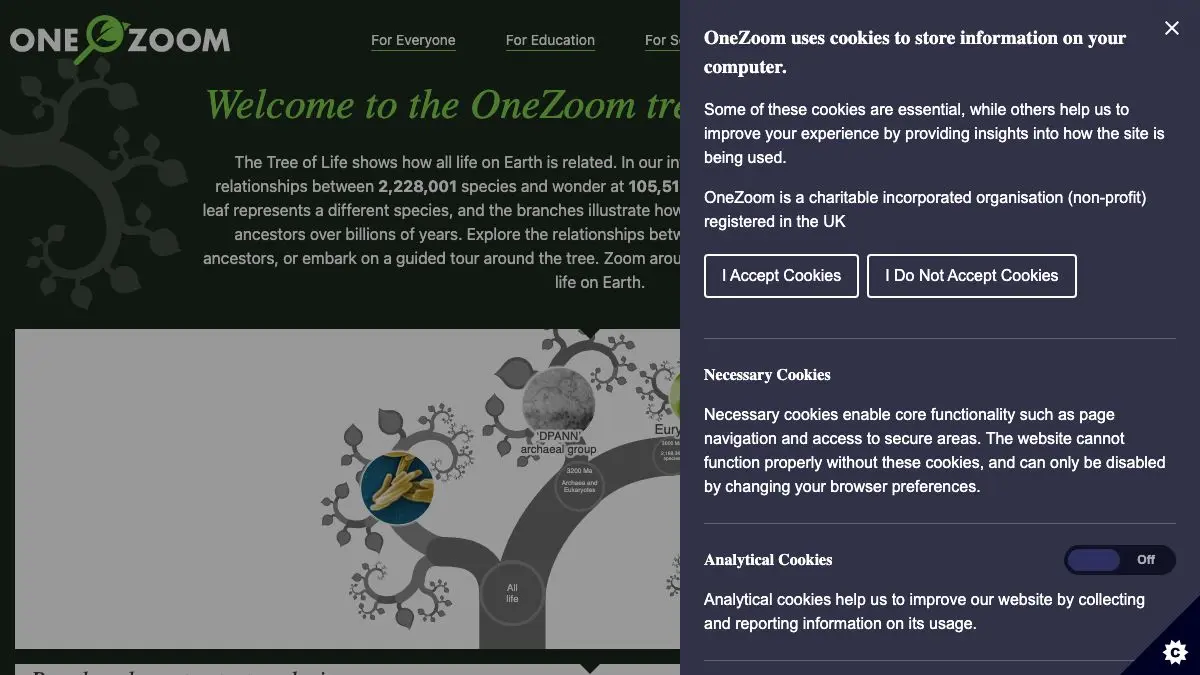
OneZoom Tree of Life draws every known species on Earth as a single fractal tree and then lets you zoom into it forever. Start at the root, pick a branch, keep going. Somewhere down one of them is a specific species of beetle with a photograph and a conservation status, and there are around 2.2 million such endpoints, which is a number you can read but not really feel until you have spent ten minutes falling through the insects.
What is OneZoom?
The problem OneZoom set out to solve is a layout problem. The tree of life is enormous and lopsided, and every attempt to print it produces either a poster with 40 branches on it or an unreadable wall of hair. You cannot show two million tips on a page.
So OneZoom stopped trying to. Instead it renders the tree as a fractal, where each branching point is drawn at a scale relative to how deep you currently are. Zoom in and new detail unfolds continuously, exactly as it does on a map. There is no page break, no separate diagram, no “see figure 4.” It is one object, and the zoom is the only navigation you need.
The project was created by evolutionary biologist James Rosindell with Luke Harmon, and it is now maintained as a nonprofit. The tree structure comes from published phylogenetics, drawing largely on the Open Tree of Life, and the decorations come from elsewhere: photographs and common names from open biodiversity databases, threat status from the IUCN Red List, and a rough popularity signal derived from Wikipedia, which is why the well-known animals tend to surface first when you search.
What makes it more than a pretty visualization is the sense of proportion it forces on you. Vertebrates, the group containing every animal anyone can name, turn out to occupy an almost embarrassing sliver of the whole. Beetles do not. Fungi go on and on. You can read that fact in a textbook and not believe it; watching the mammals shrink to nothing while you are still zooming through arthropods is a different experience.
There is also a conservation layer, which is the part that stops being fun. Color the tree by IUCN status and whole regions of it light up red.
What can you do with OneZoom?
- Zoom the whole tree. Start at the root and dive. There is no bottom until you hit an individual species.
- Search for any species. Type a common or scientific name and the view flies to it, keeping the surrounding branches visible so you can see what it sits next to.
- Compare two species. The comparison tool finds their most recent common ancestor and gives an estimate of when the lineages diverged. Try humans and mushrooms.
- Take a guided tour. Built-in tours walk you through highlights of the tree, which is a far better introduction than wandering at random.
- Color by conservation status. Switch the coloring to IUCN threat categories and read the tree as a map of what we are losing.
- Change the tree shape. Several fractal layouts are available, from natural branching to spirals and fern-like forms. They contain the same data and feel completely different.
- Browse the images. Most well-documented species carry a photograph, so deep zooming turns into an accidental tour of organisms you did not know existed.
- Run it on a big screen. There is a display mode intended for museums and exhibitions, which also works nicely on a spare monitor.
Tips to get the most out of it
Do a tour before you free-roam. Unstructured zooming is fun but disorienting. One guided tour gives you enough landmarks to know where you are the next time.
Search for something you know, then zoom out slowly. Starting from your own species and pulling back is far more instructive than starting from the root, because you can watch the familiar categories dissolve into larger ones.
Use the common ancestor tool on absurd pairings. A dolphin and a bat. A banana and a beetle. The dates are estimates, but the shape of the answer is the point.
Turn on the conservation coloring at least once. It reframes the entire tree, and it is the reason the project exists rather than just a visual trick.
Give it a real machine if you can. The deep fractal rendering is demanding, and a phone will manage but a desktop browser makes the zoom genuinely smooth.
Remember the tree is provisional. Phylogenetics is an active field and branches get rearranged when new evidence arrives. OneZoom reflects a current best understanding, not a settled one.
If you like OneZoom, also try…
- Scale of the Universe: the same zoom-until-you-lose-your-bearings trick, applied to size rather than ancestry.
- If the Moon Were Only 1 Pixel: another honest visualization of a scale that does not fit on a page.
- Bartosz Ciechanowski: interactive explanations that trust you to play with the diagram until it makes sense.
- Zoomquilt: infinite zooming with no educational excuse whatsoever.
More things that quietly rewire your sense of scale in Learning & Education.
Frequently asked questions
What is OneZoom?
OneZoom is a free online explorer that draws the entire tree of life as one continuous, zoomable fractal. It covers roughly 2.2 million known species, from bacteria to blue whales, arranged by their evolutionary relationships. You navigate it by zooming, the same way you would a map, and any branch can be followed down to individual species.
Is OneZoom free to use?
Yes. The explorer is free, requires no account, and the software is open source. The project is run by a charity and funded partly through a leaf sponsorship scheme, where supporters can dedicate a specific species on the tree.
Where does OneZoom get its data?
The tree structure is built from published phylogenetic research, drawing heavily on the Open Tree of Life project. Species images, common names, conservation status and popularity information are pulled in from other open sources including the Encyclopedia of Life, the IUCN Red List and Wikipedia. Because the underlying science keeps changing, the tree is updated as new research lands.
Can I find the common ancestor of two species on OneZoom?
Yes. There is a comparison tool where you enter two species and OneZoom jumps to the point where their branches meet, showing the shared ancestor and an estimate of how long ago the lineages split. It is the fastest way to get a concrete answer to questions like how closely related a mushroom and a human really are.