// 2026-08-05 · Learning & Education · by Bob Smith
OJAD Pitch Accent Dictionary: The Missing Half of Japanese Pronunciation
OJAD is a free University of Tokyo tool that shows Japanese pitch accent for words, conjugated forms and entire sentences, with audio and drawn pitch curves.
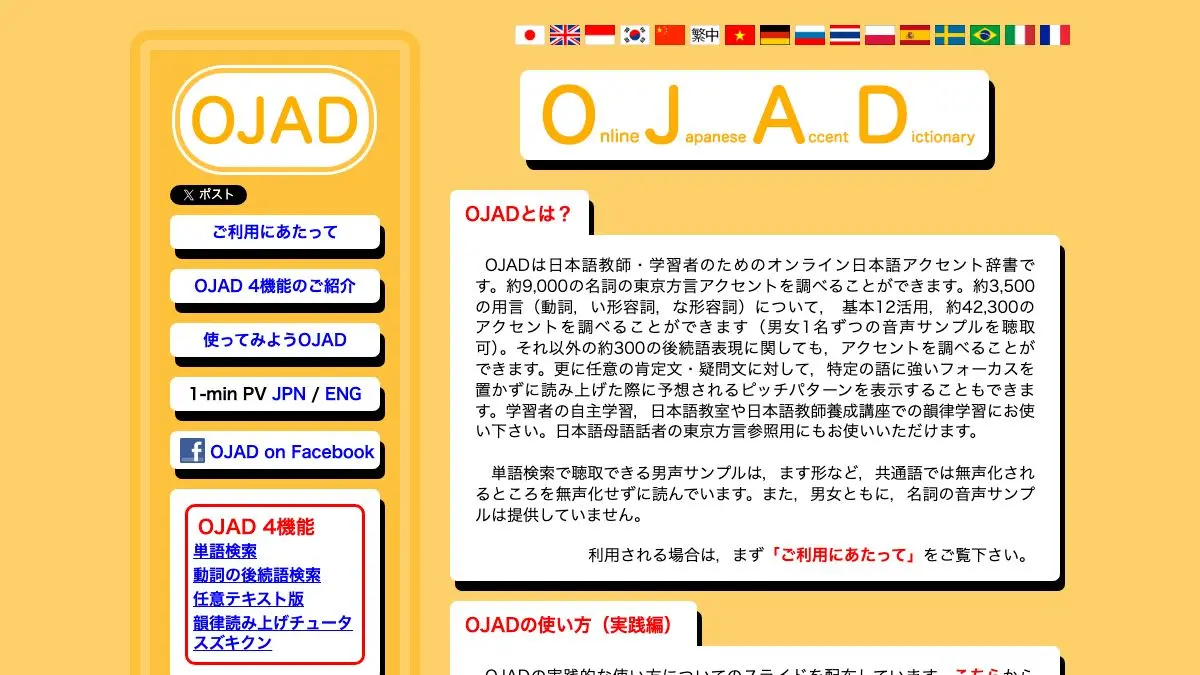
OJAD is the tool that tells you the thing your Japanese textbook never mentioned: which syllables go up and which go down. Japanese has pitch accent, most teaching materials quietly ignore it, and the result is a lot of learners with excellent grammar and a permanently slightly-off melody. This free site from the University of Tokyo is the correction.
What is OJAD?
Japanese words carry a pitch pattern. 箸 and 橋 are the same sounds with different melodies, and while context usually saves you from actual misunderstanding, the accumulated effect of getting every pattern slightly wrong is speech that sounds foreign in a way learners often cannot diagnose themselves.
The Online Japanese Accent Dictionary was built by researchers at the University of Tokyo to make that layer visible. Look up a word and you get the accent drawn as a line over the kana, showing exactly where pitch rises and where it drops, plus audio.
The genuinely useful part is that it does not stop at dictionary forms. Verbs and adjectives change their accent when they conjugate, and knowing that 食べる is accented one way tells you less than you would hope about 食べなかった. OJAD lays out the conjugated forms in a table with their patterns, which is information that is otherwise buried in specialist references.
Then there is Suzuki-kun, the sentence-level tool. Paste in a sentence, a paragraph, or a whole speech, and it predicts the pitch contour across the entire thing and reads it aloud with adjustable speed. Words behave differently in connected speech than they do in isolation, and this is the only convenient way most learners will ever see that happen.
There is also a teacher-facing side, including lookup by textbook, so you can pull the accent patterns for the vocabulary in a specific lesson of a common course book. It is very obviously a tool built by people who teach this for a living, and it looks like it: the interface is functional academic software, not a startup landing page. That is fine. It works.
What can you do with OJAD?
- Look up a single word. Search and get the accent pattern drawn over the kana, with the accent type number and audio.
- See every conjugated form. Verbs and adjectives come with a table of inflections and how the accent moves in each, which is where the real learning is.
- Run a whole sentence through Suzuki-kun. Paste text and get a predicted pitch curve for the full sentence plus synthesized speech.
- Slow the audio down. Suzuki-kun lets you reduce the speed, which makes the pitch movement much easier to hear.
- Look up vocabulary by textbook. Select a common Japanese course book and lesson and pull the accent for its word list.
- Switch interface language. OJAD is available in a number of languages, so it is not only usable by English-speaking learners.
- Compare male and female voices. The synthesized readings come in more than one voice, useful for hearing the pattern rather than the speaker.
Tips to get the most out of it
Learn to read the line before you learn the numbers. The drawn contour is instantly readable and the accent-type numbering is not. Get comfortable with the shape first, and the notation will make sense later on its own.
Put your active vocabulary through it, not random words. Checking the accent of words you already use every day fixes more of your speech than looking up rare vocabulary you will never say out loud.
Use Suzuki-kun on things you are about to say. Presentation, self-introduction, a message you are recording: run the text through, listen twice, then say it along with the audio. This is the fastest practical payoff the site offers.
Shadow, do not just read. Play the audio and speak over it. Pitch accent is a motor skill more than an intellectual one, and staring at a contour teaches your mouth nothing.
Treat the prediction as a strong hint. Suzuki-kun estimates sentence prosody automatically, and regional variation and real speakers both exist. It is far better than nothing and not an oracle.
Check verbs in the past negative. It is the form that most often surprises people, and it is a good test of whether you actually internalized a pattern or just memorized one form.
If you like OJAD, also try…
- YouGlish: hear a word pronounced by real speakers in thousands of real videos.
- Pink Trombone: a physical model of the vocal tract, for understanding how these sounds get made at all.
- Freerice: drill vocabulary in short bursts and donate rice while doing it.
- Khan Academy: structured free courses for when you want the systematic version of studying.
More study tools in Learning & Education, and more useful oddities in Tools & Utilities.
Frequently asked questions
What is OJAD?
OJAD, the Online Japanese Accent Dictionary, is a free research tool from the University of Tokyo that shows the pitch accent pattern of Japanese words. It displays accent as a drawn line over the kana, covers conjugated and inflected forms rather than just dictionary forms, and includes a feature that predicts the pitch pattern of an entire sentence you type in.
Is OJAD free to use?
Yes. OJAD is a publicly funded academic project and is free to use with no account required. It is available in several interface languages, which makes it usable for learners who are not studying through Japanese or English.
What is Suzuki-kun in OJAD?
Suzuki-kun is OJAD's sentence-level prosody tool. You paste in a Japanese sentence or paragraph and it produces a predicted pitch contour for the whole thing, with synthesized audio you can slow down. It is the fastest way to see how accent patterns shift when words are strung together, which is where most textbook accent knowledge falls apart.
Why does Japanese pitch accent matter?
Pitch accent distinguishes some words that are otherwise identical, and more importantly it is a large part of what makes speech sound natural rather than foreign. Most learning materials omit it entirely, so learners can spend years with accurate vowels and consonants and still sound obviously non-native. OJAD exists to fill that gap.
Visit OJAD Pitch Accent Dictionary →
← All posts · Browse the directory