// 2026-05-08 · Learning & Education · by Bob Smith
Khan Academy: A Free World-Class Education, Genuinely
Khan Academy offers free structured courses in math, science, economics and test prep, from counting to calculus. No ads, no catch, it's a nonprofit.
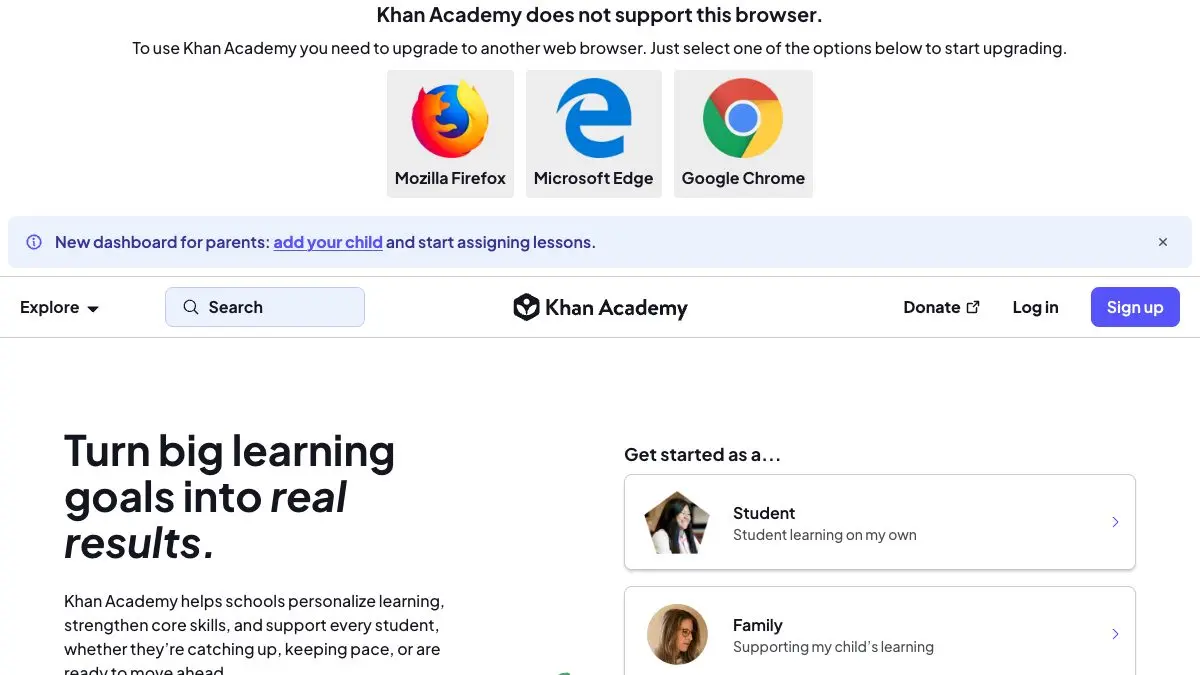
Khan Academy is a nonprofit that gives away a complete, structured education for free. Math from counting through multivariable calculus. Physics, chemistry, biology. Economics, history, computing, and test prep. Short videos, then practice problems that adapt to what you actually got wrong. No ads, no subscription, no trial.
The tagline is “a free, world-class education for anyone, anywhere.” Annoyingly, they mean it.
What is Khan Academy?
It started with one guy tutoring his cousin in math over the internet and posting the videos publicly. That turned into a nonprofit, and the nonprofit turned into the closest thing the web has to a full K-12-plus curriculum.
The bit that separates Khan Academy from “a channel with math videos” is the mastery system. Content is organized into units and skills, and the site tracks how solid you are on each one. Get things right consistently and a skill levels up toward mastery. Get things wrong and it quietly loops you back to the prerequisite you actually missed, which, in math, is nearly always the real problem. Nobody is bad at algebra; they’re shaky on fractions from six years earlier and nobody noticed.
There are also teacher and parent tools: assign work, see who’s stuck on what, and get a class-level view of where the gaps are. Schools use it in production, which is why the content is as thorough as it is.
What can you do on Khan Academy?
- Learn math end to end: early number sense, arithmetic, pre-algebra, algebra 1 and 2, geometry, trigonometry, precalculus, statistics and probability, differential and integral calculus, linear algebra and beyond.
- Take science courses with real problem sets: physics, chemistry, biology, organic chemistry, cosmology.
- Study economics and finance: micro, macro, and a genuinely useful personal-finance track on loans, interest, taxes and investing.
- Learn to code in the computing section, with an in-browser editor so you write and run programs on the page.
- Prep for standardized tests, including official partner material for some major exams.
- Take a diagnostic and let the site build a personalized path from where you actually are, rather than where the syllabus assumes you are.
- Set up Khan Academy for a child: the Kids app covers the earliest years with a much gentler interface.
Tips to get the most out of it
Take the course challenge first, not last. Every course has a challenge that tests the whole unit up front. Ace parts of it and Khan marks those skills done, so you skip what you already know instead of grinding through it.
Don’t skip the practice for the videos. The videos are the easy, pleasant part and they teach you almost nothing on their own. The exercises are where learning actually happens. If you’re watching more than you’re solving, you’re doing it backwards.
Use the hints deliberately. Every problem has a step-by-step hint chain. Using it is not cheating, but read the whole chain, then redo a fresh problem of the same type without hints. That second step is the one people skip.
Go back further than feels dignified. If a topic keeps not clicking, drop two units below where you think the problem is. It’s almost always there, and clearing it takes an afternoon instead of a semester.
Aim for streaks, not sessions. Twenty focused minutes daily beats a three-hour Sunday. The mastery system is built around spaced repetition, and it rewards showing up.
Make an account even if you’re just browsing. Progress tracking is most of the value, and without it you’ll lose the thread within a week.
If you like Khan Academy, also try…
- BetterExplained: math explained with intuition and analogy first, formulas second. A perfect companion when a Khan lesson technically makes sense but hasn’t clicked.
- Wolfram Alpha: type in the problem and get worked steps back. Useful for checking your reasoning, dangerous as a shortcut.
- Project Gutenberg: free public-domain ebooks, for when the humanities side gets curious.
- Scratch: MIT’s block-based coding playground and the friendliest possible on-ramp for a young programmer.
More in Learning & Education.
Open Khan Academy, pick the subject you quietly gave up on at school, and start two units earlier than your pride suggests. It works.
Frequently asked questions
What is Khan Academy?
Khan Academy is a nonprofit education website offering free structured courses in math, science, economics, computing, history and standardized test prep. Each course combines short video lessons with practice exercises that adapt to how you are doing. It covers everything from early primary arithmetic through early university-level subjects.
Is Khan Academy free?
Yes, completely. Khan Academy is a nonprofit funded by donations and grants, so all courses, videos, exercises and progress tracking are free with no ads and no subscription. Some newer AI tutoring features are offered separately, but the core curriculum remains free for everyone.
Is Khan Academy good enough to learn math from scratch?
Yes, it is one of the best places to do exactly that. The math track runs continuously from counting and place value up through algebra, trigonometry, statistics and calculus, and its mastery system will happily send you back to fill gaps you did not know you had.
Do I need an account to use Khan Academy?
You can watch videos and try exercises without one, but making a free account is worth it. Signing in saves your progress, unlocks the mastery tracking and course recommendations, and lets teachers or parents follow along if you want them to.