// 2026-08-05 · Entertainment & Fun · by Bob Smith
MovieLens: Film Recommendations From a University Research Lab
MovieLens recommends films based purely on your own ratings, with no ads and nothing to sell you. It is run as a research project, not a streaming service.
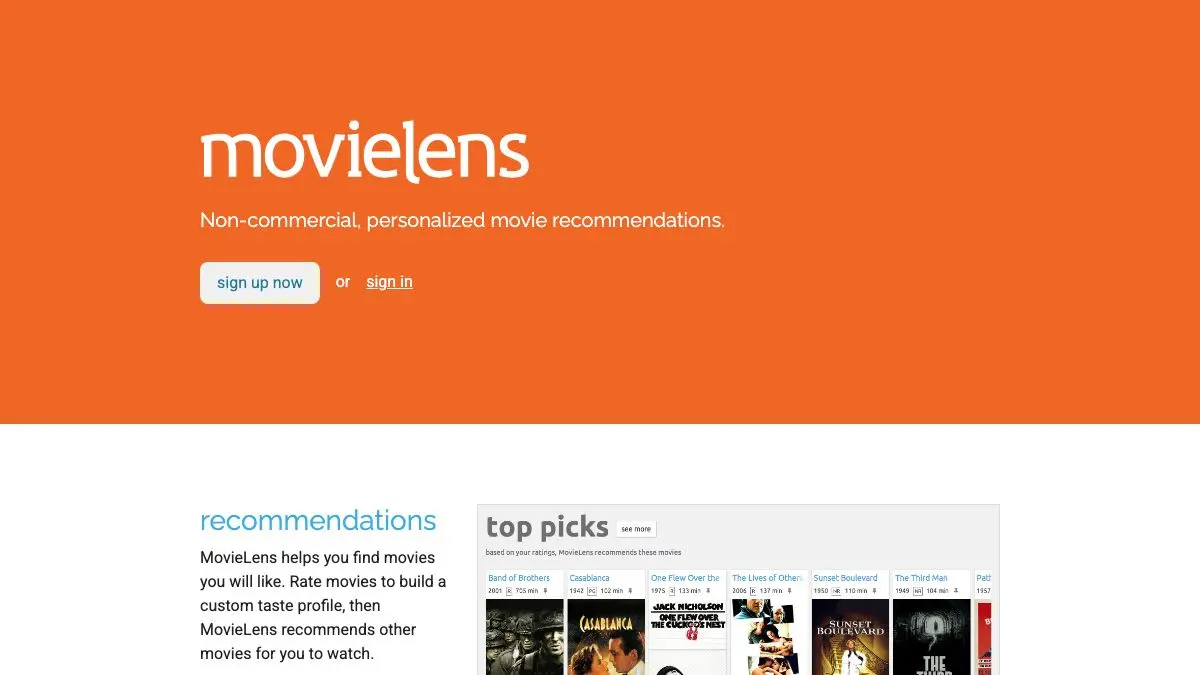
MovieLens tells you what films you will like based on what you have already rated, and it has no financial stake whatsoever in your answer. No studio paid for placement. No streaming service is nudging you toward its own catalog. Nobody is trying to keep you on the site.
It is run by a university lab, and it has been quietly doing this since the 1990s.
What is MovieLens?
MovieLens comes from GroupLens, a research group at the University of Minnesota that has spent decades working on recommender systems, the algorithms that decide what you see next on basically every platform you use. To study those systems properly you need real people rating real things, at scale, over time. MovieLens is that experiment, and it is also a genuinely good product.
The distinction from commercial recommenders is not academic. When a streaming service recommends a film, it is balancing several objectives: what you might like, what it has licensing rights to, what it needs to promote this quarter, and what will keep you subscribed. Those goals are not the same thing, and you cannot tell from the outside which one produced any given suggestion.
MovieLens has one objective. Predict, as accurately as possible, how you will rate a film. That is the whole research question. The recommendations it produces are correspondingly odd in the best way, obscure titles, thirty-year-old films, things no algorithm with a catalog to sell would ever surface.
The interface is functional rather than beautiful. It is a database with a good search, a rating widget, and predicted scores displayed alongside every title. There are no autoplay trailers, no social feed, no reels. It looks like software built by people who care about the data model.
The data itself has a second life: the MovieLens ratings datasets are among the most widely used benchmarks in recommender systems research, cited in an enormous number of papers. Your ratings are, in a small way, contributing to that.
What can you do with MovieLens?
- Rate what you have seen. The core loop. Half-star granularity, and disliked films are as informative to the model as loved ones.
- Read predicted ratings. Every film carries a prediction of your score, which is far more useful than an average of everyone else’s opinion.
- Import an existing rating history. Bring in ratings you have accumulated elsewhere rather than starting from nothing.
- Build a wishlist. Mark films to watch later, so the recommendations turn into an actual queue.
- Filter aggressively. Search by genre, year, language, and predicted score to narrow an enormous catalog to something watchable tonight.
- Explore tags. Community-applied tags describe films in ways genre labels cannot, and they are searchable.
- Contribute to research. Anonymized rating data underpins published work on how recommendation actually functions.
Tips to get the most out of it
Rate the films you hated. New users rate their favorites and stop. A model that only knows what you like has half the information it needs, and your predictions stay vague until you tell it what to avoid.
Import rather than grind. If you have years of ratings on another service, exporting and importing them takes minutes and skips the tedious cold-start phase entirely.
Use the predicted score as a filter, not a verdict. Sorting by prediction and then browsing is where the good discoveries happen. Blindly watching the top-predicted film is less interesting than scanning the top hundred for something you have never heard of.
Rate in batches over time. Sitting down and rating two hundred films at once produces worse calibration than adding ratings as you actually watch things, because your standards drift when you rate from memory in bulk.
Do not expect availability information. This is a recommender, not a streaming guide. It will happily suggest something you then have to go and find elsewhere.
Give it a month before judging it. The predictions are mediocre at fifty ratings and genuinely impressive at five hundred. Most people who dismiss it quit before the model knew anything about them.
If you like MovieLens, also try…
- A Good Movie to Watch: hand-picked films with a short reason for each, when you want a human recommendation.
- TasteDive: “if you liked this, try that” across films, books, music and games.
- BestSimilar: another similarity engine for finding the next thing in the same vein.
- JustWatch: once MovieLens tells you what to watch, this tells you where it is streaming.
More ways to decide what to do with an evening in Entertainment & Fun, and more well-built public datasets in Data & Research.
Frequently asked questions
What is MovieLens?
MovieLens is a non-commercial film recommendation site run by GroupLens, a research lab at the University of Minnesota. You rate movies you have seen and it predicts how much you will like ones you have not. Because it exists to support recommender systems research rather than to sell anything, there are no ads and no commercial partnerships influencing the results.
Is MovieLens free?
Yes, it is free and has always been free. You need to create an account so it can store your ratings, but there is no paid tier and nothing is being marketed to you.
How many movies do I need to rate to get good recommendations?
The site asks for a batch of initial ratings when you sign up, and the predictions improve steadily as you add more. A few dozen ratings gives you something usable, and a few hundred gives you predictions that are often unnervingly accurate. Rating films you disliked matters as much as rating ones you loved.
Can I import my ratings from IMDb or Letterboxd?
MovieLens supports importing ratings from an exported file, which is the fastest way to get a large rating history in without starting from scratch. Export formats change over time on the source services, so check the current import instructions on the site before you begin.