// 2026-08-05 · Data & Research · by Bob Smith
judyrecords: Full-Text Search Across Hundreds of Millions of Court Cases
judyrecords lets you search the full text of hundreds of millions of United States court cases for free, with no account, no paywall and no per-document fees.
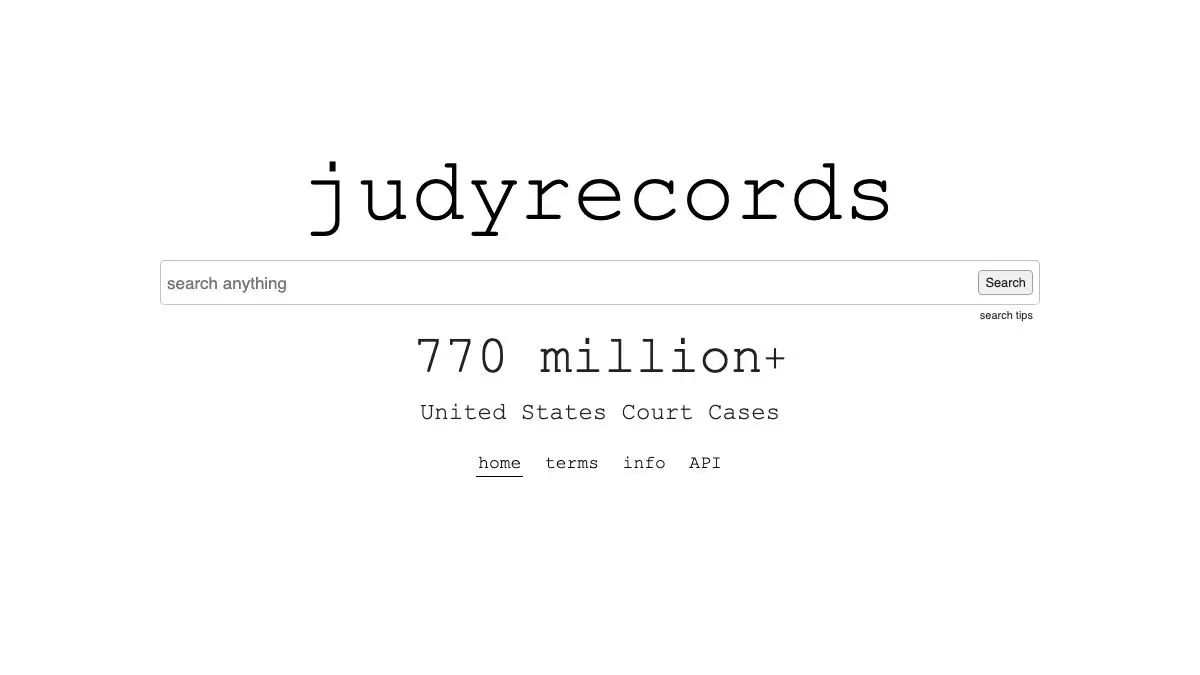
judyrecords does something the American legal system has spent decades making expensive: it lets you search court records, in full text, across hundreds of millions of cases, for free, without an account.
Type a name, a phrase, a company, an unusual turn of legal language. Hit enter. It comes back fast.
What is judyrecords?
Court records in the United States are public in principle and awkward in practice. They are scattered across thousands of county and state systems, each with its own interface, its own search limitations and often its own fees. The federal system charges per page for access. The commercial legal databases that sit on top of all this cost more than most people will ever justify.
judyrecords is the counter-argument. It aggregates court records from a large number of jurisdictions into a single index and makes the whole thing full-text searchable, which is the crucial part. Most official court search tools let you look up a case if you already know the party name or the docket number. Full-text search means you can find cases by what is actually written inside them: a phrase in a filing, a company mentioned in passing, an address, a specific claim.
That inverts who can use the archive. If you have to know the case to find the case, the archive only serves people who already have the information. If you can search the text, you can start from a question.
It is fast, which matters more than it sounds. Legal research interfaces are traditionally sluggish and hostile. This one behaves like a search engine, because it is one.
Coverage is the honest caveat. It is broad but not uniform. Some jurisdictions are indexed thoroughly, others sparsely, and some not at all, reflecting what each court system actually publishes and how. Nothing returned means nothing was found in what has been indexed, which is a different claim from nothing exists.
Journalists, researchers, people trying to understand a dispute they are caught up in, and the merely curious all use it. So do plenty of lawyers, quietly, before they spend money on a paid search.
What can you do with judyrecords?
- Search full case text. Find cases by phrases, names, companies or terms that appear inside the documents, not just in case captions.
- Look up a party. Individual and corporate names return their appearances across the indexed jurisdictions.
- Research a company’s litigation history. Searching a business name surfaces disputes that never made the news.
- Follow a legal phrase. Distinctive contract language or a specific claim can be traced across many filings.
- Read case details. Results link through to case information without a paywall stopping you at the interesting part.
- Start research before spending money. It is a free first pass that tells you whether a paid database search is worth running.
Tips to get the most out of it
Use quotes for exact phrases. Full-text search rewards precision. A distinctive phrase in quotation marks cuts through a lot of noise that a bare name search will drown you in.
Search variations of a name. Court clerks transcribe names inconsistently, and entities appear under legal names, trade names and abbreviations. Try several before concluding a party is absent.
Treat empty results as a gap, not an answer. Coverage varies by jurisdiction. If you need to know that something does not exist, that has to be confirmed with the relevant court, not with this search box.
Never use it to make a decision about a person. Court databases are full of dismissed charges, sealed matters, expunged records and people with the same name. Formal background screening in the United States is legally regulated for exactly this reason, and this is not that.
Verify anything you plan to publish. A search hit is a lead. Before it goes into an article or a filing, get the actual document from the court and confirm it says what the index suggests.
Combine it with corporate research. Court filings name entities, and pairing a case with ownership and subsidiary research turns a single dispute into a picture of a whole organization.
If you like judyrecords, also try…
- LittleSis: a database of who runs things and who they are connected to, which pairs naturally with litigation records.
- Violation Tracker: corporate penalties and enforcement actions, aggregated and searchable.
- Internet Archive / Wayback Machine: the other great free archive, for when the evidence you need was a web page.
- Semantic Scholar: the same principle applied to academic literature, free and full-text.
More public records prised open in Data & Research.
Frequently asked questions
What is judyrecords?
judyrecords is a free search engine for United States court records. It indexes hundreds of millions of cases from courts across the country and lets you search their full text, rather than only case names or docket numbers. Results link through to the case details, and there is no account, subscription or per-document charge.
Is judyrecords really free?
Yes. Searching and reading is free with no registration, which is unusual in a field where the established services charge per page or per search. The project is independently run and positions free public access to court records as its entire reason for existing.
What kinds of cases can I find?
Coverage skews toward state and county court records across many United States jurisdictions, spanning civil, criminal, family and other case types. Coverage is not uniform: some jurisdictions are indexed deeply and others thinly or not at all, so an absence of results does not mean an absence of cases.
Can I use judyrecords for a background check?
You should not rely on it for that. Formal background checks in the United States are regulated, and court databases contain expunged, sealed, dismissed and mistaken-identity records that can badly mislead. Use it for research and orientation, and go to the court itself or a compliant service when a decision about a person is involved.