// 2026-08-05 · Data & Research · by Bob Smith
LittleSis: The Free Database of Who the Powerful Know
LittleSis maps the connections between billionaires, executives, politicians and board seats. A free, citation-backed who-knows-who of the powerful.
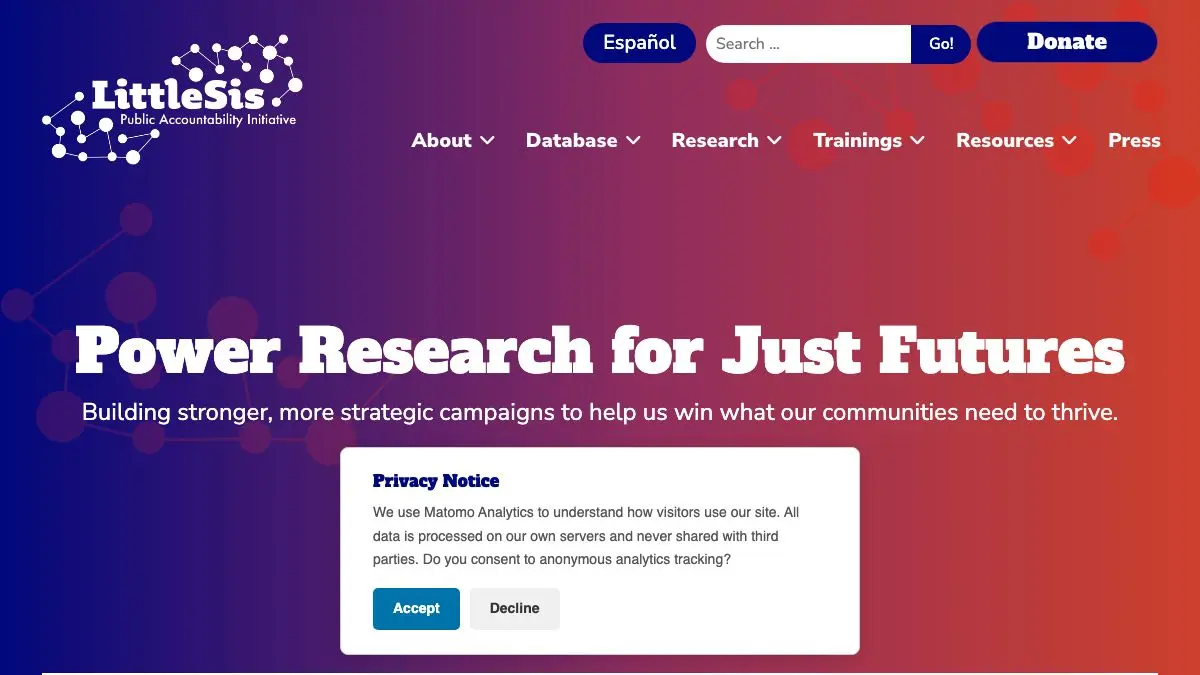
LittleSis is a free database of who the powerful know. Type in a billionaire, a senator, a bank or a think tank, and it shows you the boards they sit on, the campaigns they funded, the people they went to school with and the organizations they quietly fund. Then it draws the whole thing as a network map.
The name is a joke, and a good one. It is the opposite of Big Brother: instead of the powerful watching everyone, everyone watches the powerful.
What is LittleSis?
Power in most countries is not organized as a conspiracy. It is organized as a social network, and social networks leave paperwork. A person joins a board, and there is a filing. A person donates to a campaign, and there is a disclosure. A person leaves a regulatory agency for the industry they regulated, and there is a press release celebrating it.
LittleSis is what happens when someone collects all that paperwork and links it together. It is run by the Public Accountability Initiative, a nonprofit research group, and it has been building the same database since around 2009.
Each entry is a profile — a person, a company, a nonprofit, a government body — and each profile lists relationships. Board member of. Donated to. Employed by. Lobbied for. Married to. Every relationship has a date range where one is known, and usually a source link so you can verify the claim rather than take it on faith.
The killer feature is Oligrapher, the built-in network mapping tool. Pick a few entities, and it draws the connections between them as a graph you can rearrange, annotate and publish. Investigative journalists and local campaigners use it to produce the “here is who is actually behind this development project” diagrams you have seen circulating, and you can make your own in about ten minutes.
The coverage skews heavily American — corporate boards, federal politics, big philanthropy, university trustees — which is a limitation worth knowing going in. Within that scope, it is remarkable how often a search reveals a link you would never have gone looking for.
What can you do with LittleSis?
- Look up a person. Search a name and get their known employers, board seats, donations, memberships and personal connections, each with dates and sources.
- Look up an organization. Companies, nonprofits, PACs, agencies and universities all have profiles listing their leadership, funders and affiliates.
- Find the path between two entities. The tool will trace how a given executive connects to a given politician, sometimes in one hop, sometimes in four.
- Build a network map with Oligrapher. Drag entities onto a canvas, let it pull in the known edges, then annotate and share the result.
- Browse existing maps. Other users have already mapped fossil fuel funding networks, private prison boards, local development deals and plenty more.
- Follow the money in local politics. The database is not only national figures — city officials, regional developers and state-level donors turn up too.
- Check the sources. Nearly every claim links out to the filing or article it came from, which makes the whole thing usable as a research starting point rather than a rumor mill.
- Contribute. Registered users can add relationships and correct old ones, which is how the coverage keeps expanding.
Tips to get the most out of it
Treat it as a lead generator, not a verdict. LittleSis tells you that two people share a board. It does not tell you they conspired. The value is in knowing where to look next, and the citations exist precisely so you can go look.
Check the dates on every relationship. A person who left a board in 2011 is displayed alongside a person who joined last year. Relationships carry start and end dates, and skipping them is the single easiest way to draw a wrong conclusion.
Start from an organization, not a person. Organizational profiles usually have far more edges attached, so you get a much richer initial picture and can work outward to individuals from there.
Use Oligrapher for anything you want to explain to someone else. A list of relationships is hard to read. The same information as a graph is instantly legible, and the maps export cleanly for a post or a presentation.
Cross-check with the primary source before publishing anything. The database is volunteer-maintained and entries can lag reality. Click the citation, confirm it still says what the entry claims, and cite the original.
Expect gaps, especially outside the US. Thin coverage of a person is not evidence they have no connections. It usually means nobody has entered them yet — which you can fix.
If you like LittleSis, also try…
- ImportYeti: free customs records showing which factory actually makes a given company’s products.
- Violation Tracker: a searchable record of corporate fines and settlements, sorted by parent company.
- Quiver Quantitative — Congress Trading: stock trades disclosed by US legislators, searchable by name and ticker.
- Connected Papers: the same network-graph idea, applied to academic literature instead of people.
More paper trails worth pulling on in Data & Research.
Frequently asked questions
What is LittleSis?
LittleSis is a free online database that documents the relationships between powerful people and organizations — corporate board seats, campaign donations, government appointments, think tank affiliations and family ties. It is run by the nonprofit Public Accountability Initiative and describes itself as the opposite of Big Brother. Entries are compiled from public records and news reporting, with sources attached.
Is LittleSis free to use?
Yes. Browsing profiles, running searches and building network maps are all free, and no account is needed to read. A free account lets you edit entries and save the maps you create. The underlying data is also available in bulk for researchers.
Where does LittleSis get its data?
From public sources: SEC filings, campaign finance disclosures, lobbying registrations, nonprofit tax returns, government records and published journalism. Volunteer editors and staff add and verify entries, and most claims carry a citation you can click through to check yourself.
Can anyone edit LittleSis?
Registered users can add and correct information, wiki-style, but edits are reviewed and the project asks for a source on factual claims. It is a smaller and more curated community than Wikipedia, so changes tend to be checked rather than fought over.