// 2026-08-05 · Entertainment & Fun · by Bob Smith
Dan-Ball: Powder Game and a Deep Catalog of Physics Sandboxes
Dan-Ball is the home of Powder Game, Stick Ranger and a long catalog of Japanese browser physics sandboxes, all free, all still updated, all built by one developer.
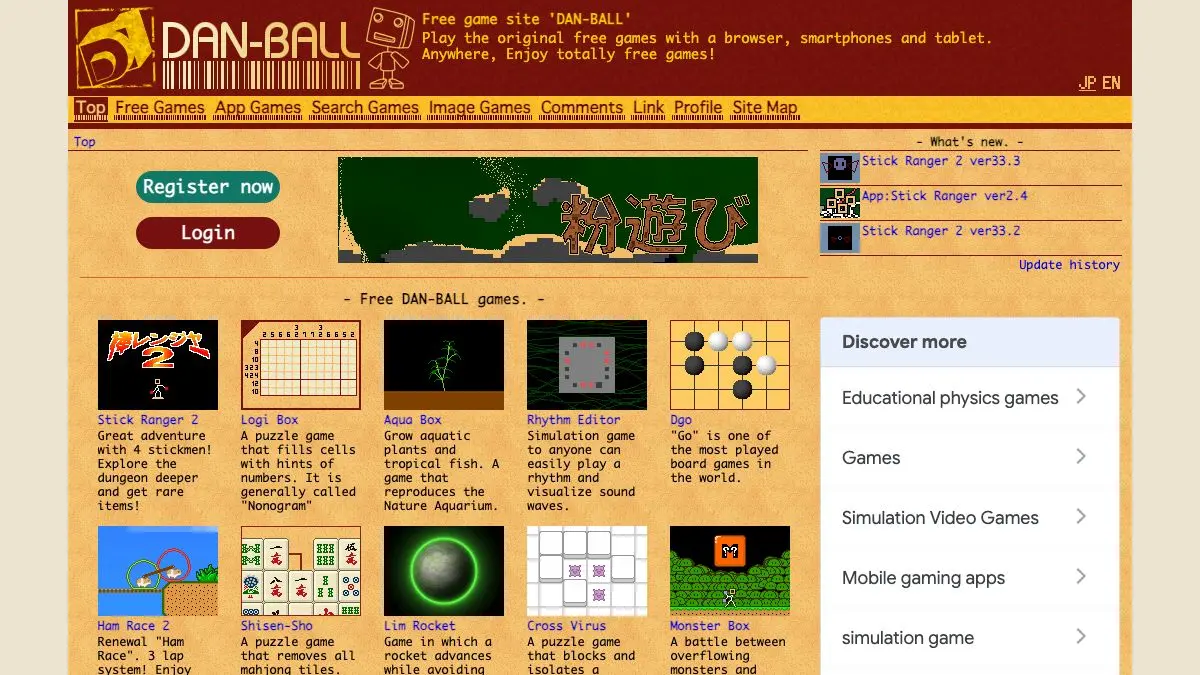
Dan-Ball is what happens when one developer spends two decades quietly building browser games and never stops. The site looks like a personal homepage from 2005, because it essentially is one, and behind the plain list of links sits some of the most-played physics sandbox software on the web.
If you have ever spent an hour dropping magma onto ice to see what happens, there is a good chance you were on this site.
What is Dan-Ball?
Dan-Ball is the work of a Japanese developer who goes by ha55ii. There is no studio, no publisher, no funding round. There is a homepage, a list of games, and an English mirror for everyone who arrived from outside Japan.
The flagship is Powder Game, a falling-sand simulator. You select a material, you paint it onto the canvas, and physics takes over. Sand piles up. Water flows and finds its level. Fire spreads and consumes what it touches. Gunpowder does what gunpowder does. Add wind, and everything in the scene is picked up and thrown. Add electricity, and you can wire up circuits. Add blocks and moving objects and you have a machine.
There is no goal, no score and no tutorial, which is exactly why people stayed. Powder Game is a toy in the strict sense: a system with consistent rules, no objectives, and enough depth that people build genuinely elaborate things in it. The shared gallery is where that becomes obvious. Finished scenes can be uploaded, replayed and voted on by other players, so the site accumulated years of contraptions built by strangers, rocket launches, chain reactions, animated pictures drawn entirely in materials.
Powder Game 2 extends the idea with more materials and more interactions. Around them sits a whole catalog: Stick Ranger, a side-scrolling RPG with stick figures and a surprisingly serious loot and class system that people have played for years; Earth Editor and Planet Simulation, which apply the same sandbox logic at planetary scale; and a long tail of smaller experiments from across the site’s history.
The whole thing survived the death of Flash, which killed most of its contemporaries. The games were rebuilt to run natively in modern browsers, and the site is still being updated, which after twenty years is the genuinely impressive part.
What can you do on Dan-Ball?
- Play Powder Game. Select materials, paint, and watch the simulation resolve. Start with water and fire, escalate from there.
- Wire up electricity and wind. The two systems that turn a sandbox into an engineering problem. Most of the impressive gallery uploads depend on them.
- Browse and replay the gallery. Thousands of user-uploaded scenes you can load and watch run. The best way to learn what the simulation can actually do.
- Upload your own scenes. With a free account you can publish creations and collect votes from other players.
- Play Stick Ranger. A full side-scrolling RPG with classes, drops and stat builds, rendered entirely in stick figures.
- Try Earth Editor and Planet Simulation. Sandbox physics scaled up to terrain, atmosphere and planets.
- Dig through the back catalog. Years of smaller games and experiments, most of them unlike anything on a commercial games portal.
Tips to get the most out of it
Start by watching the gallery, not by building. Load a few top-rated Powder Game uploads and watch them run. You will learn more about material interactions in ten minutes than an hour of experimenting alone.
Learn what wind does early. It is the single most transformative tool in Powder Game. Almost every scene that looks impossible is built on wind interacting with something else.
Use the pause and step controls. The simulation moves fast. Pausing to place materials precisely, then stepping forward, is how people build things that actually work instead of things that immediately catch fire.
Give Stick Ranger more than five minutes. It looks like a joke and plays like a real RPG with a genuine grind, class specialization and build decisions. It is a much longer commitment than anything else on the site.
Use the English site. The /en/ version covers the main games. Some of the deeper corners and community pages are still Japanese-only, and a browser translation handles them fine.
Expect an old-web interface. Dense menus, small text, no onboarding. The games are excellent; the navigation is from another era and is not going to change.
If you like Dan-Ball, also try…
- The Powder Toy: the desktop heavyweight of falling-sand simulation, with vastly more materials and a serious modding scene.
- Sandspiel: a beautiful minimalist browser take on the same idea, with a shared world.
- Sandboxels: hundreds of elements and reactions, including a lot of extremely silly ones.
- Orb Farm: a tiny self-contained ecosystem to build and then anxiously keep alive.
More simulations to lose an evening to in Entertainment & Fun.
Frequently asked questions
What is Dan-Ball?
Dan-Ball is a Japanese website of free browser games made by a single developer known as ha55ii. It is best known for Powder Game, a falling-sand physics sandbox, and also hosts Stick Ranger, Earth Editor, Planet Simulation and a long list of other experiments. An English version of the site is available.
Is Dan-Ball free to play?
Yes. The games are free and run in the browser. You can play without an account, though registering lets you upload your own creations to the shared galleries and vote on other people's.
What is Powder Game?
Powder Game is a falling-sand simulator where you paint materials such as sand, water, fire, gunpowder, magma and various gases onto a grid and watch them interact. It includes wind, electricity, blocks and moving objects, and finished scenes can be uploaded and replayed by other players. Powder Game 2 is a later version with additional materials.
Do Dan-Ball games still work without Flash?
Yes. The games were rebuilt to run in modern browsers after Flash was retired, and the site is still actively maintained. Some of the very oldest entries in the catalog are more basic than the flagship titles, but the main games work normally.