// 2026-06-28 · Weird & Wonderful · by Bob Smith
Orb Farm: Grow a Tiny Sealed World in Your Browser
Orb Farm lets you build a sealed aquatic ecosystem from sand, water, algae and fish, then watch it balance itself. A free browser terrarium that keeps growing.
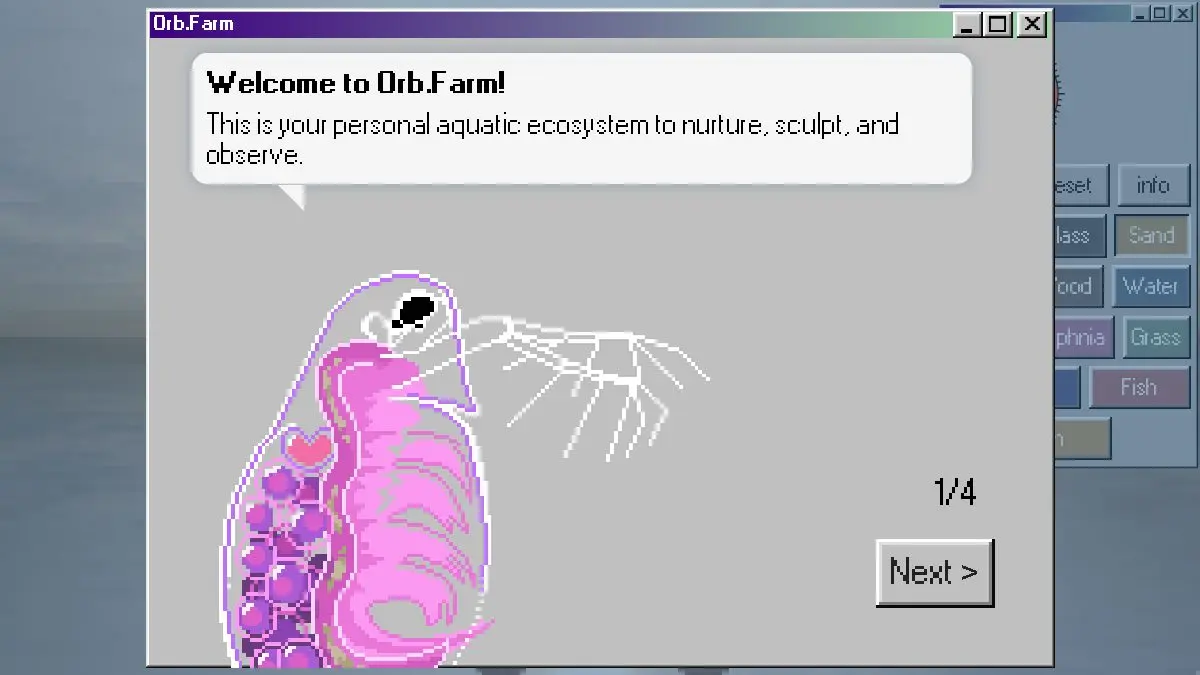
Orb Farm is a free browser toy where you build a tiny sealed world inside a glass sphere. Drop in sand, pour in water, seed some algae, plant a few strands of green, then add fish and small creatures, and watch a genuine little ecosystem try to find its balance. Nothing to install, nothing to buy. Just a jar of pixels that is quietly alive.
What is Orb Farm?
Picture one of those sealed glass ecospheres people keep on a desk: water, gravel, algae, a couple of shrimp, hermetically closed forever. Orb Farm is that, simulated, and infinitely more forgiving because you can start over.
Underneath, it’s a particle simulation in the falling-sand tradition, sand really falls, water really flows, and everything is made of individual grains obeying tiny rules. But the tone is completely different from the usual burn-it-all sand toy. Orb Farm isn’t about destruction. It’s about whether the thing you made can keep itself going.
That flips the whole feeling of the genre. Instead of “what happens if I set this on fire,” you’re asking “is there enough light reaching the bottom” and “did I add fish too early.” It turns out that’s an extremely relaxing question to sit with.
The orb also rewards patience in a way most browser toys don’t. Leave it running and things change on their own. Algae blooms. Plants creep up from the substrate. Populations rise and crash and rise again. You can walk away and come back to a world that has visibly moved on without you.
What can you do on Orb Farm?
The interface is a ring of brushes and a couple of sliders. That’s it. Everything else is consequence.
- Lay down substrate. Sand at the bottom is where plants take root. How you shape it: flat bed, sloped bank, a hill breaking the surface, decides where life can grow.
- Add water. Fill the orb partway or all the way. Leaving an air gap changes everything about how the top of your world behaves.
- Seed algae and plants. This is the engine of the whole system. Green things make oxygen and food. Without them nothing else lasts.
- Introduce animals. Fish and smaller critters can be dropped in once the place looks habitable. They eat, they move, they die if the balance is wrong.
- Control the environment. Sliders let you push light and heat up or down. More light means more growth: up to a point. Too much of either and things start going wrong in ways that are very satisfying to diagnose.
- Wreck it and rebuild. Nothing is precious. Scrape the whole orb clean and start again with what you learned.
The loop that emerges is lovely: build, wait, notice something dying, adjust one variable, wait again. It’s a science experiment where the equipment is free and the stakes are zero.
Go tend one at orb.farm.
Tips to get the most out of it
- Plants first, always. The single most common mistake is adding fish to a bare orb because fish are the fun bit. They will die. Build a thick, obviously thriving mat of algae and plant growth, let it stabilize, then introduce animals.
- Don’t fill the orb to the top. An air gap at the surface gives you gas exchange and a visible waterline, and it makes the whole thing look far more like a real terrarium. It also gives you somewhere for things to float.
- Shape the sand deliberately. A flat floor is boring and it’s also worse. Build slopes, ledges and a shallow shelf near the light. Different depths create different micro-habitats, and you’ll see growth patterns you never get from a flat bed.
- Change one slider at a time. When your orb starts failing, resist the urge to crank everything. Move light or heat, then watch for a while. Simulations like this are only legible if you treat them like experiments.
- Let it run long. The first two minutes are the least interesting two minutes Orb Farm has. Open it in a background tab and check back. The good stuff, blooms, crashes, recoveries, happens on a timescale that rewards leaving it alone.
If you like Orb Farm, also try…
- Sandspiel: the same particle-simulation DNA, aimed at chaos instead of care. Sand, fire, acid and a gallery of other people’s creations.
- The Powder Toy: the maximalist version: hundreds of elements, real heat and pressure, working electronics.
- Explore.org Live Cams: real ecosystems, live, from bear rivers to coral reefs. The non-simulated version of the same pleasure.
- OCEARCH Shark Tracker: follow tagged sharks around the actual ocean in near real time.
- More oddities await in Weird & Wonderful.
Frequently asked questions
What is Orb Farm?
Orb Farm is a free browser toy where you build a tiny sealed aquatic ecosystem inside a glass sphere. You add sand, water, algae, plants and fish, adjust the light and temperature, and the simulation works out whether your little world survives. It is closer to a terrarium than a game.
Is Orb Farm free?
Yes, Orb Farm is completely free and runs in your browser with nothing to install or sign up for. Just open the page and start placing sand and water.
Why did my fish die in Orb Farm?
Almost always because the ecosystem could not support them. Fish need oxygen and food, which come from healthy algae and plants, and both of those need light. Build a green, thriving orb first and add animals only once the plant life is clearly stable.
Does Orb Farm keep running when I close the tab?
Orb Farm is a live simulation that runs while the page is open, so the interesting changes happen while you are watching or leaving the tab open in the background. Treat it like a real aquarium: the rewarding part is coming back to check on it.