// 2026-08-05 · Learning & Education · by Bob Smith
Arts & Letters Daily: The Web's Longest-Running Reading List
Arts & Letters Daily has posted three columns of curated essays, criticism and book reviews since 1998, in a layout that has barely changed and does not need to.
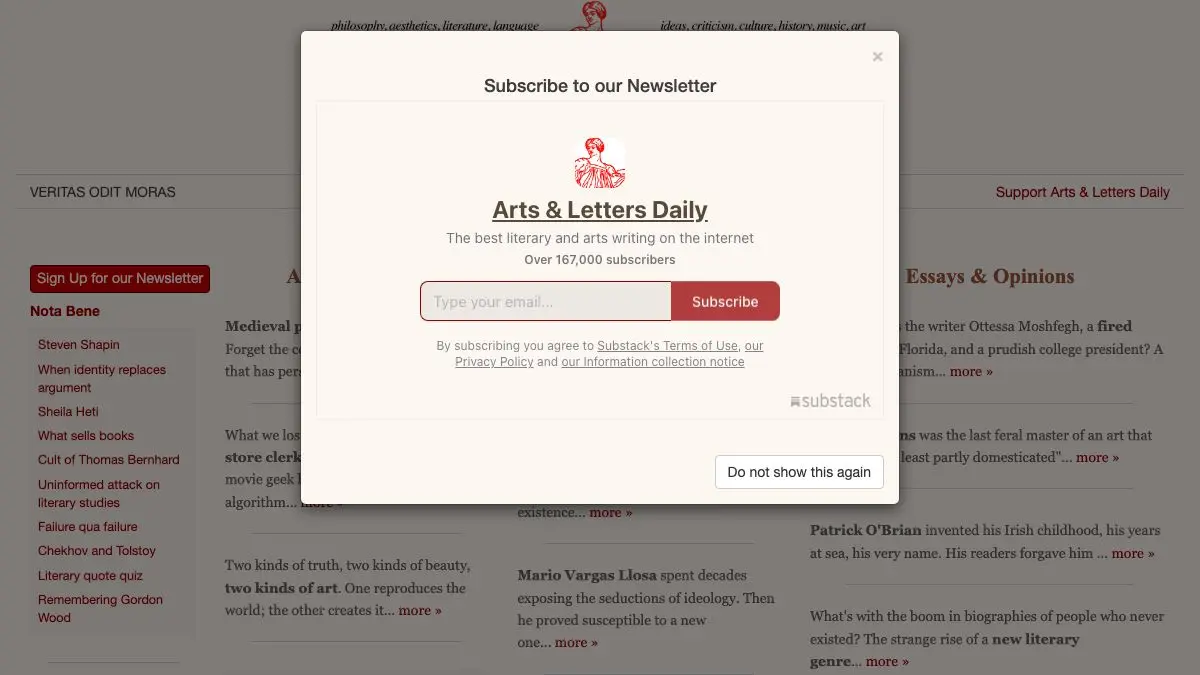
Arts & Letters Daily has looked essentially the same since 1998, and that is not a criticism. Three columns of small text. No images. No video. No algorithm. Just several hundred words a day of teasers pointing at the best essays, criticism and book reviews anyone published this week.
It is the reading list the internet has been failing to replace for over twenty-five years.
What is Arts & Letters Daily?
It was founded by Denis Dutton, a philosopher of aesthetics who had the correct instinct at exactly the right moment: the web was about to fill with excellent long-form writing scattered across hundreds of publications, and nobody would ever find it. So he read everything and posted the good parts.
The structure has never changed. Articles of Note, New Books, Essays and Opinion. Each item is a compact teaser, a few sentences that set up an idea and then stop, mid-thought, handing you a link. It is a small, ruthless piece of editorial craft. Done badly this is clickbait; done this way it is a précis that tells you enough to decide honestly whether you want the next four thousand words.
The sourcing is genuinely global and genuinely broad. Literary magazines, academic journals with something readable in them, national newspapers, small reviews, obscure quarterlies. A single day might carry a piece on Byzantine economics, a hatchet job on a new biography, and an argument about consciousness that you will think about on the train.
Dutton died in 2010, and the site has continued under The Chronicle of Higher Education, which acquired it years earlier. It has kept both the editorial standard and the refusal to redesign. Down the left side sits a standing directory of newspapers, magazines, book review sections and columnists, which was a normal thing for a website to have in 1999 and is now a small act of preservation.
The archive is the underrated part. Every item posted since the beginning is still there, which makes it an accidental record of what the thinking public was arguing about, year by year, for a quarter of a century.
What can you do with Arts & Letters Daily?
- Read the three daily columns. Articles of Note for essays and reporting, New Books for reviews, Essays and Opinion for argument.
- Use the teasers as a filter. Each one gives you enough to judge whether the full piece is worth your next twenty minutes, which is more than most headlines manage.
- Dig through the archive. Items going back to the late nineties, searchable, forming a strange and useful history of public intellectual life online.
- Work the left-hand directory. A hand-maintained list of publications, book review sections and columnists that functions as a map of where good writing actually lives.
- Follow the book reviews. New Books is one of the better ways to keep up with serious nonfiction without reading publisher marketing.
- Read it on anything. Plain HTML, no scripts fighting you, loads instantly on a bad connection and reads fine on a phone.
Tips to get the most out of it
Visit, do not subscribe. This is a site that rewards deliberate arrival. Piped into a feed reader alongside everything else it becomes noise, and the whole point is that someone already did the filtering.
Open three tabs, close the site. The failure mode is browsing teasers for twenty minutes and reading nothing. Pick three, open them, leave.
Read outside your lane on purpose. The curation is broad specifically so you can end up in a five-thousand-word piece about eighteenth-century cartography you would never have gone looking for. That is the value, not the pieces already in your field.
Keep a reading-later app handy. Many linked essays are long. Sending them somewhere for later is more realistic than pretending you will read a Harper’s feature at 11pm on a Tuesday.
Mine the archive by year. Picking a year at random and reading what was considered urgent then is unexpectedly clarifying about what is considered urgent now.
Accept the paywalls. A share of links will hit a subscription wall. That is the price of it pointing at real publications rather than only free content farms, and plenty of the sources are open.
If you like Arts & Letters Daily, also try…
- MetaFilter: the community version of the same instinct, with human comment threads attached.
- Read Something Interesting: one good article at a time, chosen for you, with no columns to scan.
- Everything2: a writing community from the same era where the entries are essays rather than encyclopedia stubs.
- Project Gutenberg: when the essay sends you to the book it keeps citing.
More reading that will not fit in a lunch break in Learning & Education and Data & Research.
Frequently asked questions
What is Arts & Letters Daily?
Arts & Letters Daily is a curated links page for serious nonfiction writing, founded in 1998 by the philosopher Denis Dutton. It posts short teasers linking out to essays, criticism, book reviews and opinion pieces from magazines and newspapers around the world, arranged in three columns. It is published by The Chronicle of Higher Education.
Is Arts & Letters Daily free?
The site itself is free and needs no account. Some of the articles it links to sit behind paywalls at their original publications, which is a limitation of the sources rather than of the site.
How often is Arts & Letters Daily updated?
It is updated very frequently, typically with new items several times a week including weekends. Older items move into a large searchable archive that stretches back to the site's founding in the late 1990s.
What are the three columns on Arts & Letters Daily?
The page is divided into Articles of Note, New Books and Essays and Opinion. Each entry is a short teaser paragraph that breaks off mid-thought and hands you a link to the full piece elsewhere. The left-hand side also carries a long standing list of newspapers, magazines, book review sections and columnists.