// 2026-08-05 · Weird & Wonderful · by Bob Smith
Your/You're: The Link You Send Instead of Arguing
youryoure.com is one page that settles your versus you're for good, plus twenty more word pairs people get wrong. Built to be linked at someone, silently.
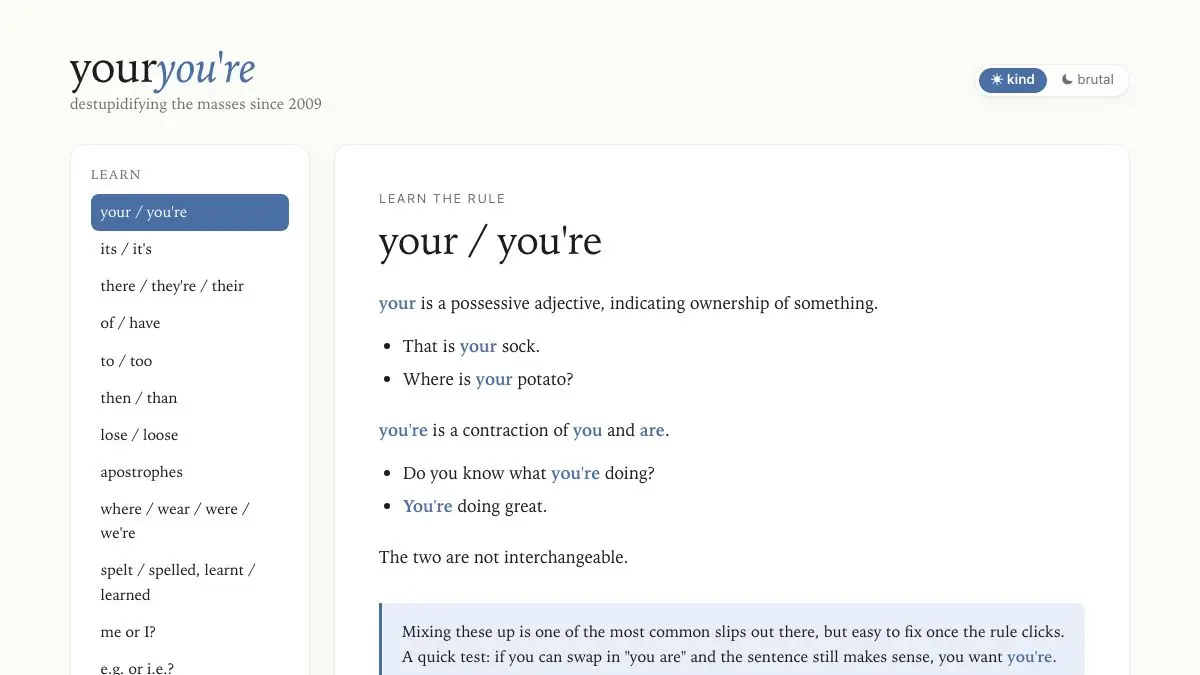
Your/You’re exists so that you never have to type the explanation yourself again. Someone in a group chat writes “your welcome.” You paste the link. You say nothing further. The matter is closed.
That is the entire product, and it has been working since 2009.
What is Your/You’re?
Built by Matt Thornton and running for well over a decade, youryoure.com describes its mission as “destupidifying the masses,” which sets the tone accurately. It is not a gentle educational resource. It is a weapon with a URL, designed from the ground up to be deployed at a person.
The design serves that purpose exactly. It is one page. It loads instantly. The domain name announces the topic before the recipient has clicked, which means the message is delivered even if they never open it. There is no signup wall, no cookie negotiation, no “5 Grammar Mistakes You’re Making” listicle padding. The rule, an example, a test, done.
The lesson itself is the correct one to teach. Your is possessive, that is your sock. You’re is a contraction of you are, you’re doing great. And the tool it hands you is substitution: try replacing the word with “you are.” If the sentence survives, you needed the apostrophe. That single test resolves the confusion permanently, which is why the site has never needed a version two.
Under the headline lesson sits a menu of twenty-plus other pairs that cause the same trouble. Its and it’s. There, their and they’re. Affect and effect. Principle and principal. Each one gets the same compressed treatment. The site quietly became a general-purpose reference for the confusable-words genre while presenting itself as being about one apostrophe.
There is also a clip from Friends embedded on the page, because the definitive pop-culture explanation of this exact rule already exists and there was no sense in reinventing it.
What can you do with Your/You’re?
- Send it instead of correcting someone. The core use case. A bare link is shorter, funnier and considerably less insufferable than a paragraph.
- Learn the substitution test. Swap in “you are.” If it reads fine, use you’re. This works every time with no exceptions to memorize.
- Browse the other pairs. Its/it’s, there/their/they’re, affect/effect and a long list of others, each on the same one-screen model.
- Settle affect versus effect. The pair most adults still quietly guess at, explained without grammatical jargon.
- Share it directly. The page carries share buttons for the usual platforms, because that is how it was always meant to travel.
- Bookmark it for editing work. If you review other people’s writing, having the reference one keystroke away is faster than explaining the rule again.
Tips to get the most out of it
Send the link with no comment. This is the single most important tip. Any accompanying text turns a joke into a lecture, and lectures do not change anyone’s spelling.
Learn the substitution trick properly and you can retire the site. “You are” either fits or it does not. Once that reflex is installed you will never think about this again, which is the outcome the site actually wants.
Read the its/it’s page too. It is the harder pair, because possessive normally takes an apostrophe and this is the exception. Most people who have mastered your/you’re are still guessing here.
Aim it at strangers, not at people you like. Linking this at a friend is funny once. Linking it at a friend twice is a personality.
Do not deploy it at someone writing in a second language. They are doing better than you would in theirs, and the site’s tone does not travel well in that direction.
Check your own posts first. The autocorrect on most phones is actively hostile to this particular distinction, and there is no dignity in sending this link from a message containing the error.
If you like Your/You’re, also try…
- The Cube Rule of Food: another single page that settles a stupid argument permanently and with total confidence.
- Down For Everyone Or Just Me: the other link you send to end a conversation rather than continue it.
- gail.com: a one-page site built entirely around correcting a persistent human error.
- Hemingway Editor: for when the problem with your writing is bigger than one apostrophe.
More single-page obsessions in Weird & Wonderful, and things that genuinely improve your writing in Productivity.
Frequently asked questions
What is youryoure.com?
It is a single-page grammar reference explaining the difference between your and you're, built by Matt Thornton and online since 2009. It describes its own mission as destupidifying the masses. Alongside the headline lesson it covers twenty-plus other commonly confused word pairs such as its and it's, there, their and they're, and affect and effect.
What is the difference between your and you're?
Your is possessive, it shows that something belongs to you, as in that is your sock. You're is a contraction of you are, as in you're doing great. The reliable test is substitution: if you can replace the word with you are and the sentence still makes sense, you need you're.
Is youryoure.com free?
Yes. It is a plain web page with no account, no paywall and nothing to install. The whole point is that it loads instantly and can be linked anywhere.
What else does the site cover?
It has a menu of other frequently confused pairs, including its and it's, there, their and they're, affect and effect, and principle and principal. Each gets the same short treatment: the rule, an example, and a test you can apply in your head.