// 2026-08-05 · Weird & Wonderful · by Bob Smith
gail.com: The FAQ of a Woman Who Will Not Sell You Her Domain
gail.com is where you land when you mistype gmail.com. Its owner answered the resulting questions in one dry, patient FAQ, and no, it is not for sale.
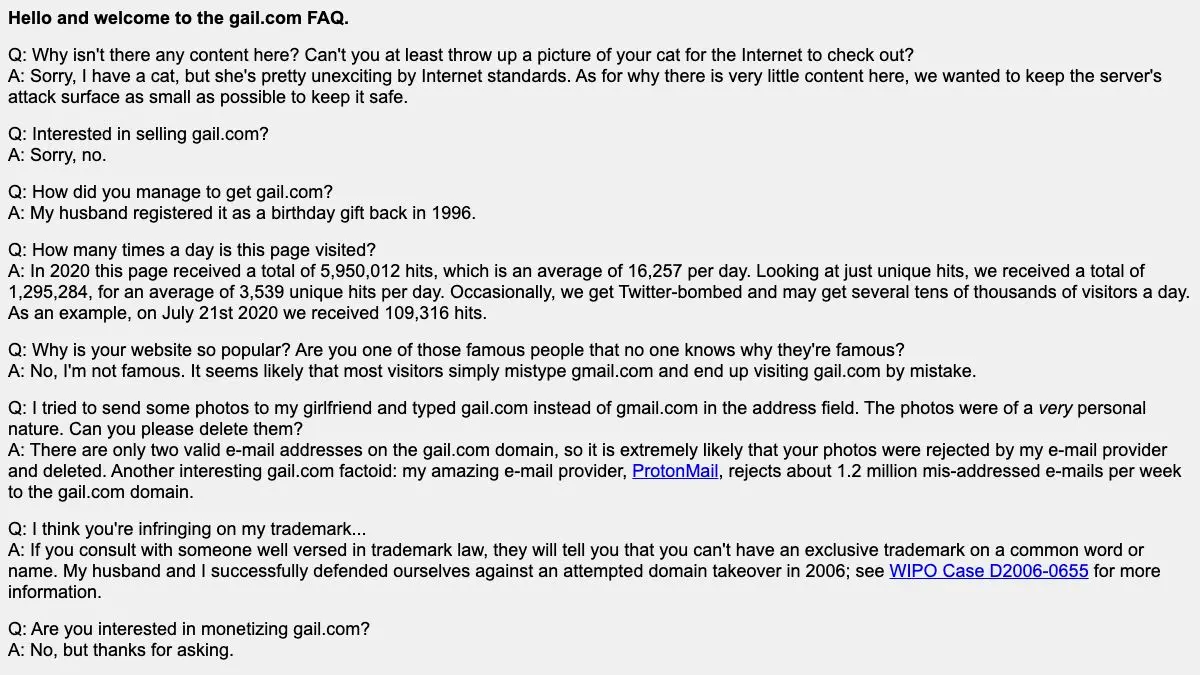
gail.com is what you get when you type gmail.com and your finger misses the m. Millions of people have done it. Most of them see an unfamiliar page, blink, and retype. A stubborn minority instead decide to write to the owner, and it is their emails that made this site what it is: a short, dry, immaculately patient FAQ from a woman named Gail explaining that no, she will not be selling.
It is the funniest thing on the internet that is technically just a support document.
What is gail.com?
The domain has belonged to the same person since 1996, when her husband registered it as a birthday present. That was a fairly whimsical gift at the time. Gmail did not exist yet and would not for another eight years, at which point Gail’s ordinary personal domain quietly became one of the most-mistyped addresses on the web.
The site’s own FAQ puts daily traffic at something like sixteen thousand visits, essentially all of it people who meant to check their email. A far larger volume arrives as mail: the FAQ notes that her provider rejects well over a million misdirected messages a week, unread, at the server.
Faced with this, the owner made a decision that deserves a small monument. She did not put up ads. She did not park the domain, monetize the traffic, or build a landing page for a business she does not run. She wrote a FAQ.
The questions on it are the ones the internet actually sends her. Why isn’t there any content here. Are you interested in selling. How did you get this domain. Why is it so popular. I accidentally sent personal photos to this address, can you delete them. Is this trademark infringement. Have you considered monetizing. Why don’t you run ads.
The answers are short. Several are one line. The reply to the purchase offers is, in essence, “Sorry, no.” There is no gloating and no lecture, just the tone of someone who has answered this exact question several thousand times and has arrived at maximum efficiency.
It is not a pushover of a site, either. There was a formal attempt to wrest the domain away through the standard dispute process in 2006, and it failed. The FAQ mentions this the way you might mention having once had a flat tire. She also declines advertising and points visitors at the Electronic Frontier Foundation instead, which tells you most of what you need to know about the operation.
The page is deliberately thin, too. Minimal content, minimal attack surface, nothing that could be mistaken for a login form by the many confused people who land there expecting one. Given the traffic it receives from people who think they are opening their inbox, that restraint is a genuine public service.
What can you do with gail.com?
- Read the FAQ. It takes ninety seconds and it is the whole point.
- Appreciate the answer to the sale question. It is two words long and has held for decades.
- Learn what typo traffic actually looks like. The numbers on the page are a rare public glimpse at the scale of a single missing keystroke.
- See a domain dispute that the little guy won. The FAQ links to the 2006 case, which is a small piece of internet legal history.
- Take the hint about your own email. If a page mentions that a million messages a week arrive at the wrong address, some of them were probably yours.
Tips to get the most out of it
Read the questions before the answers. They are a portrait of the internet’s manners. Someone genuinely wrote to ask whether personal photos sent to a stranger’s domain could be deleted on request.
Notice what is missing. No ads, no affiliate links, no newsletter, no cookie banner, no crypto pivot. A domain this valuable running this quietly is close to extinct.
Check the WIPO case if you like that sort of thing. It is a short, readable example of what happens when someone tries to argue a person should not be allowed to own their own first name.
Do not send an offer. The FAQ exists precisely so you do not have to. Whatever number you were thinking of, the answer is still no.
Type carefully from now on. This is the actual takeaway. Somewhere out there is a server bouncing a million of these a week, and every one of them was someone’s real email to someone real.
If you like gail.com, also try…
- The Million Dollar Homepage: another single domain that accidentally became internet history and was never touched again.
- Down For Everyone Or Just Me: one question, one answer, no website surrounding it.
- Ling’s Cars: the polar opposite approach to owning a domain, and equally uncompromising.
- Arngren: a website that has resisted redesign for even longer, for entirely different reasons.
Find more of the internet’s stubborn originals in Weird & Wonderful, and more single-purpose pages that do one job in Tools & Utilities.
Frequently asked questions
What is gail.com?
gail.com is a personal domain belonging to a woman named Gail, and it is the address a large number of people reach every day by leaving the m out of gmail.com. Rather than build a website, the owner has published a short FAQ answering the questions she is repeatedly asked, most of which are about whether she will sell it.
Is gail.com related to Gmail or Google?
No. It is an unrelated personal domain that happens to be one keystroke away from a very large email service. The FAQ makes the lack of affiliation clear, largely because so many visitors arrive convinced they are logging into their inbox.
Why won't the owner sell gail.com?
Because she does not want to. The FAQ says the domain was a birthday gift from her husband in the 1990s, and the answer to every purchase inquiry is a polite refusal. She has also successfully defended the domain against a formal attempt to take it away.
What happens to emails sent to gail.com by mistake?
They do not reach the person you meant to write to. The site notes that a very large volume of misdirected mail is rejected at the server rather than delivered or read, and the owner cannot retrieve or delete anything you sent to the wrong address. Check the recipient before you hit send.