// 2026-07-22 · Learning & Education · by Bob Smith
Animated Knots: Every Knot, Tied Step by Step
Animated Knots shows knots as step-by-step animations you can scrub through frame by frame. Free, clear, and genuinely the best knot resource on the internet.
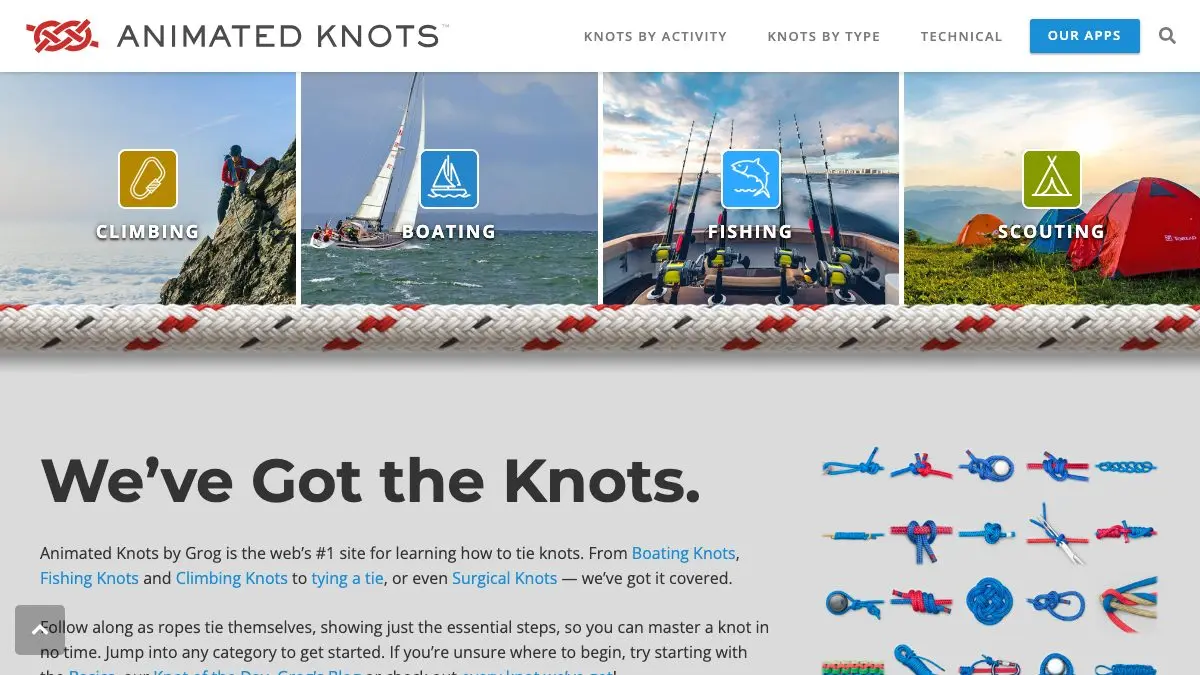
Animated Knots is a free reference site that teaches you to tie knots by showing them as step-by-step animations you control. Not a diagram with confusing arrows. Not a shaky video where the instructor’s hands block the crucial moment. Just the rope, moving through each essential step, one frame at a time, until it is obvious.
It has quietly been the best knot resource on the internet for years, and it deserves far more attention than it gets.
What is Animated Knots?
Animated Knots exists because knots are almost impossible to learn from still pictures. The whole difficulty is in the sequence: which strand goes over, which goes under, which way the loop turns. A photograph of a finished bowline tells you nothing about how it got there.
So the site animates the process instead, stripping each knot down to just the essential steps. You step through them at your own pace, forward and backward, as many times as you need. The rope appears to tie itself. What was a confusing tangle becomes a series of four or five obvious moves.
The library is enormous and beautifully organized. You can browse by activity, boating, climbing, fishing, scouting, arborist, rescue, even surgical and neckties, or by type, which groups knots the way riggers think about them: bends, hitches, loops, stoppers, splices, bindings. That dual organization is the difference between “I need a knot for tying my kayak to a roof rack” and “I need a bend, what are my options?”
What can you do on Animated Knots?
- Step through any knot frame by frame, forward or backward, at your own speed. This is the core feature and it is perfect.
- Browse by what you are actually doing. Going sailing? Open the boating section. Climbing? There is a section for that, with the knots the sport actually uses.
- Browse by knot family when you want to understand the underlying logic rather than just copy a procedure.
- Read the notes on each knot. Every entry explains what the knot is for, how it behaves under load, and importantly, where it fails or should not be used.
- Compare similar knots side by side, which is how you finally understand the difference between a sheet bend and a becket bend, or why a bowline is not a slip knot.
- Take it offline with the iOS and Android apps, which matter more than you would think when you are on a boat with no signal and a rope in your hands.
Tips to get the most out of it
- Have rope in your hands before you open the page. Watching a knot animation without rope is entertainment. Watching it with rope is learning. A metre of paracord costs almost nothing and lives in a drawer forever.
- Tie it three times, then walk away. Repetition immediately after learning is what moves a knot from your eyes to your fingers. Come back the next day and tie it from memory before you look again.
- Learn six knots properly instead of forty badly. Bowline, figure eight, clove hitch, two half hitches, sheet bend, taut-line hitch. That set handles the overwhelming majority of everyday situations.
- Read the “uses” and cautions, not just the steps. Knowing that a knot slips under certain loads, or jams solid after being loaded hard, is the difference between a useful knot and a dangerous one.
- Learn the knot’s mirror image too. Tie it left-handed and upside down. Real situations rarely present the rope in the tidy orientation the animation uses, and this is what separates people who can tie a bowline from people who can tie a bowline behind their back.
- Use the activity sections as a shopping list. Before a trip, open the relevant activity page and practice those five knots. Ten minutes of prep beats improvising in the rain.
If you like Animated Knots, also try…
- How a Car Works: the same instinct for clear, illustrated, practical explanation applied to engines and brakes.
- Bartosz Ciechanowski: interactive essays that explain physical mechanisms better than anything else on the web.
- MuscleWiki: click a body part, get demonstrated exercises, same click-and-learn energy.
- Khan Academy: for when you want a full course rather than a reference.
Browse more practical knowledge in our Learning & Education collection.
Frequently asked questions
What is Animated Knots?
Animated Knots, also known as Animated Knots by Grog, is a free reference site that demonstrates knots as step-by-step animations rather than static diagrams. Each knot is broken into its essential steps so you can advance through them one at a time and see exactly where the rope goes. Knots are organized both by activity, such as boating or climbing, and by type, such as bends, hitches and loops.
Is Animated Knots free?
Yes, the website is free to browse with no account required. There are also paid mobile apps for iOS and Android for people who want the same reference available offline, out on a boat or up a crag where there is no signal.
What is the best way to learn a knot on Animated Knots?
Step through the animation with an actual piece of rope in your hands, matching each frame before you advance. Tie it three times in a row, then try again the next day from memory. The site's step-by-step format is designed exactly for this kind of hands-on repetition.
Which knots should a beginner learn first?
A small set covers almost every everyday situation: a bowline for a fixed loop, a figure eight as a stopper, a clove hitch or two half hitches for attaching to a post, a sheet bend for joining two ropes of different sizes, and a taut-line hitch for adjustable tension. Animated Knots has clear step-by-step animations for all of them.