// 2026-07-16 · Learning & Education · by Bob Smith
The Evolution of Trust: Game Theory You Can Play
The Evolution of Trust is a playable explainer that turns the prisoner's dilemma into a game you actually understand. Free, brilliant, 30 minutes well spent.
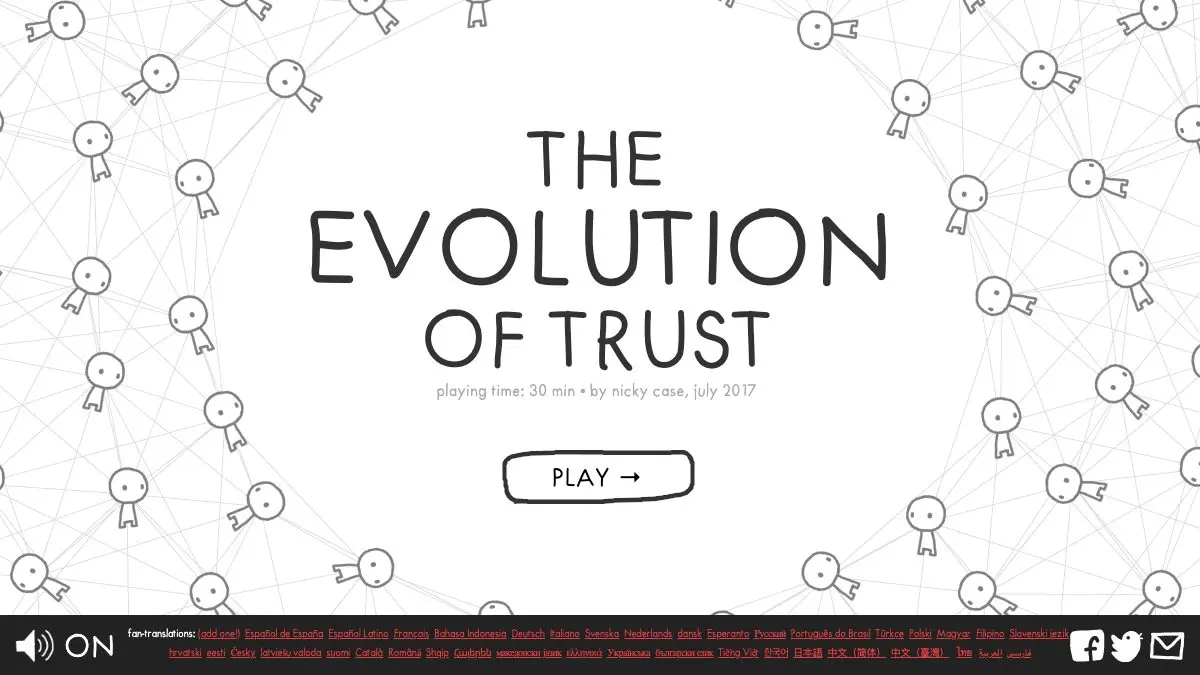
The Evolution of Trust is a free, playable explainer about game theory that makes the prisoner’s dilemma finally click. You play short rounds against a cast of computer opponents, watch which ones prosper, then run whole tournaments and evolutionary simulations to see which strategies take over the world. Half an hour in, you understand cooperation better than you did after every article you have ever read about it.
It is one of the best things on the internet. Genuinely.
What is The Evolution of Trust?
Made by Nicky Case, The Evolution of Trust takes the most famous problem in game theory and refuses to explain it with equations. Instead it puts a coin machine in front of you. You can cooperate or cheat. So can the other player. The payoffs are laid out plainly, and the first choice you make is yours.
Then it introduces the cast. Copycat does whatever you did last time. Always Cooperate is a saint. Always Cheat is exactly what it sounds like. Grudger forgives nothing, ever. Detective probes you first and adapts based on what it finds. Each one is a personality and a strategy at the same time, which is why they stick in your head long after the numbers fade.
Once you have met everyone, the machine takes over. Tournaments run. Populations shift. Strategies that seemed unbeatable get eaten alive when the conditions change. And the conditions are the whole point.
What can you do on The Evolution of Trust?
- Play the basic game by hand against each character, one round at a time, so you feel the logic before you see the math.
- Run a tournament where every strategy plays every other strategy, and watch the leaderboard settle.
- Run an evolutionary simulation where winning strategies reproduce and losing ones die out, generation after generation.
- Turn up the noise. Add miscommunication so that sometimes a cooperate is read as a cheat. This single slider is the most important thing on the site and it changes everything.
- Change the payoffs and the number of rounds to see when cooperation stops being worth it at all.
- Open the sandbox at the end and build your own population from scratch, mixing strategies in whatever proportions you like.
There is a story running through all of it, told in short bursts of text with a light touch and a real point to make about why trust collapses in some environments and flourishes in others.
Tips to get the most out of it
- Do not skip the manual rounds. It is tempting to rush to the simulations, but playing by hand is what makes the strategies feel like characters rather than labels. That intuition carries the rest of the piece.
- Push the noise slider all the way and watch Grudger collapse. In a perfect world, unforgiving strategies do fine. Add a 5% chance of a misread signal and the whole hierarchy reshuffles. This is the single most quotable finding on the site.
- Shrink the number of rounds to one. Everything cooperative dies. That is the mathematical case for why one-off interactions with strangers feel so much colder than repeated ones with neighbors.
- Build a doomed population in the sandbox on purpose. Fill the world with Always Cooperate, then drop in a single cheater. Watching the invasion is more instructive than any warning about it.
- Play it with someone else in the room. The arguments about which strategy should win are half the fun, and the simulation settles them in about four seconds.
If you like The Evolution of Trust, also try…
- Universal Paperclips: another game that hides a serious idea inside a deceptively simple interface.
- BetterExplained: math explanations built on intuition first, formulas second.
- Bartosz Ciechanowski: jaw-dropping interactive essays on gears, light, cameras and more.
- The Pudding: visual essays that let you play with the data instead of just reading about it.
Find more brain food like this in our Learning & Education collection.
Frequently asked questions
What is The Evolution of Trust?
The Evolution of Trust is a free interactive explainer by Nicky Case that teaches game theory through play. You make choices in a repeated prisoner's dilemma against different computer characters, then run tournaments and evolutionary simulations to see which strategies survive. It takes about thirty minutes and explains more about cooperation than most textbooks.
Is The Evolution of Trust free?
Yes, completely. It runs in your browser with no account, no ads and no paywall, and the creator has released it into the public domain so anyone can remix, translate or teach with it.
What does The Evolution of Trust teach?
It teaches the core lesson of iterated game theory: cooperation can beat selfishness, but only under specific conditions. You learn how repeat encounters, the payoff structure and communication errors each change which strategy wins, and why trust is fragile in low-repeat, high-noise environments.
How long does The Evolution of Trust take?
Around thirty minutes for a full playthrough, though you can stop and return at any point. The sandbox at the end has no ending at all, so people who enjoy tinkering often spend far longer than that.
Visit The Evolution of Trust →
← All posts · Browse the directory