// 2026-07-06 · Entertainment & Fun · by Bob Smith
SCP Foundation: The Wiki That Documents Monsters
SCP Foundation is a collaborative fiction wiki where thousands of writers document impossible objects in cold clinical prose. Free, endless, unnerving.
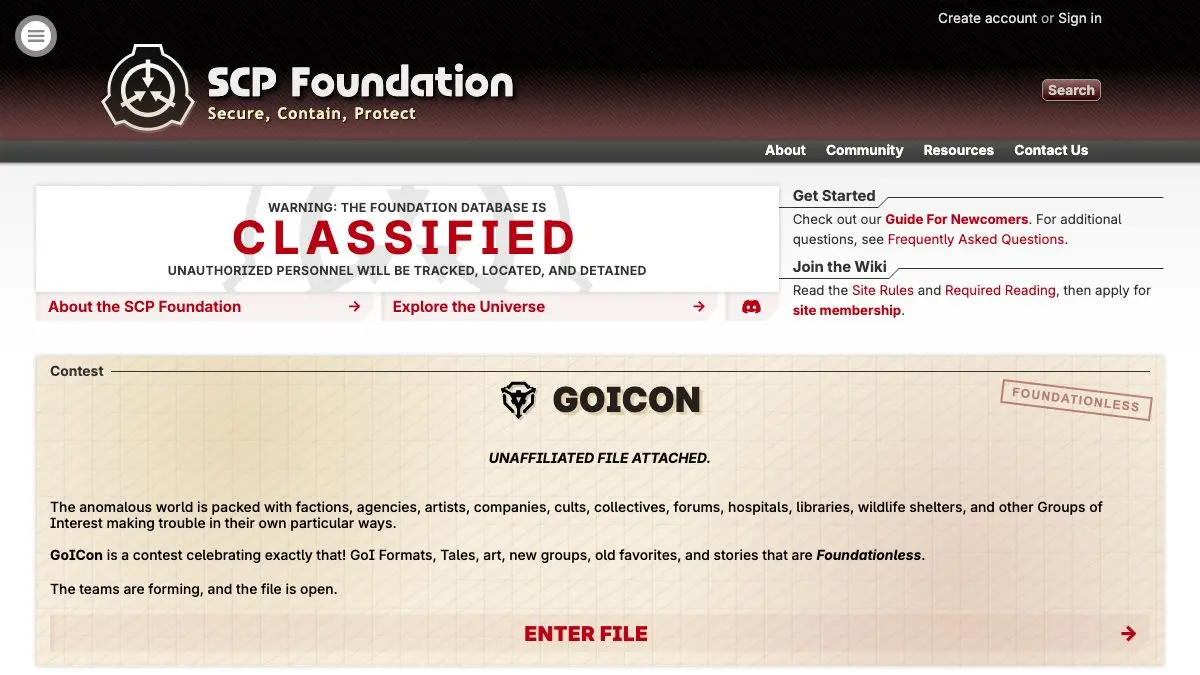
The SCP Foundation is a collaborative fiction wiki with thousands of entries, each one documenting an impossible object as if it were a boring government file. A statue that moves when you blink. A staircase that goes down forever. A rubber duck. The horror is not in the monster, it is in the paperwork tone used to describe it. You will start with one article and surface four hours later.
What is the SCP Foundation?
The premise is beautifully simple. Somewhere out there, a secret organization exists to Secure, Contain, and Protect everything that breaks the laws of physics. The wiki is their filing cabinet, leaked.
Every article follows the same skeleton: an item number, an object class, a set of Special Containment Procedures, and a Description. Then, often, an appendix, an incident report, a redacted interview transcript, a note from a researcher who is clearly not okay.
That rigid format is the whole trick. Nobody tells you to be scared. The document just calmly explains that personnel must not look away, that the site lost eleven staff on Tuesday, and that the containment chamber is to be cleaned once daily. Your brain fills in the screaming.
And it is all written by volunteers. Thousands of them, over nearly two decades, building one enormous shared universe with no editor-in-chief, just a rating system, a critique culture, and a deletion policy that quietly removes anything that does not earn its place.
What can you do on the SCP wiki?
More than read horror stories, though that is the headline act.
- Browse the numbered series. SCP-001 through SCP-9999 and beyond, split into series of a thousand. Each has its own index page.
- Read the Tales. Short fiction set in the same universe: no containment procedures, just characters living inside this world. Some are funny. Some will wreck you.
- Explore the Canons. Loose shared settings that groups of writers built together, each with its own tone and rules and recurring cast.
- Meet the other groups of interest. The Foundation is not alone. There are rival organizations, cults, and one deeply unserious anomalous art collective.
- Fall into the joke articles. Officially sanctioned nonsense, numbered with a -J suffix. The wiki takes itself seriously enough to have a designated place for not doing that.
- Follow the international branches. SCP has active wikis in many languages, each writing original entries, and the English site hosts translations.
Tips to get the most out of it
Do not start at SCP-001. It is not the beginning. It is a locked box containing many competing “proposals,” each claiming to be the true first anomaly, and reading them cold spoils a dozen later payoffs. Start elsewhere and come back.
Use the Top Rated pages as your filter. With thousands of articles, quality varies. The community rating system is genuinely useful, sort by rating within a series and you will hit the good stuff immediately.
Read the tags. Every article is tagged, and the tag index is a fantastic way to browse by mood. Want only the ones about buildings? Only the ones tagged “keter”? It is all there.
Trust the higher numbers. Newcomers assume the early articles are the best because they are the most famous. The writing craft on the wiki has improved enormously over the years, and Series III and beyond hide some of the finest short horror fiction on the internet.
Click the author pages. When an article lands, find who wrote it and read their other work. SCP has genuine auteurs, and following a writer is more rewarding than crawling the index.
Read one aloud. The clinical voice is funnier and creepier when someone performs it deadpan. This is why the audio adaptations work so well.
If you like the SCP Foundation, also try…
- Library of Babel: a website containing every book that could ever be written, including this sentence. Infinite text, near-zero meaning, deeply unsettling.
- Neal.fun: the opposite mood, same “one page swallowed my afternoon” energy. Interactive toys that teach you something sideways.
- The Wiki Game: if you enjoy wiki-crawling as a sport, this turns it into a race.
- Wiby: a search engine for the strange, handmade corners of the web that algorithms forgot.
More rabbit holes live in our Entertainment & Fun collection, and the Weird & Wonderful shelf is right next door.
Frequently asked questions
What is the SCP Foundation?
The SCP Foundation is a collaborative fiction wiki where thousands of anonymous writers document imaginary anomalous objects, creatures, and places as if they were classified files. Each entry is written as a dry containment report, object class, containment procedures, description, which makes the impossible read like paperwork. None of it is real, but the format is so consistent that it feels like a leaked archive.
Is the SCP Foundation free?
Yes. Every article on the SCP wiki is free to read, with no account and no paywall. The entire body of work is released under a Creative Commons Attribution-ShareAlike license, which is why SCP stories get adapted into games, videos, and art so freely.
Where should a beginner start with SCP?
Start with the site's own 'Top Rated' list rather than SCP-001, which is deliberately a puzzle with multiple competing versions. Classic entry points include SCP-173, SCP-096, and SCP-682, but the best modern writing tends to sit in the higher-numbered series. Read three or four, then follow whatever tale links off the ones you liked.
Can anyone write an SCP article?
Yes. The wiki is open to new writers, and there is a guided drafting process plus critique forums where regulars tear your draft apart before you post it. Articles are rated by readers, and low-rated entries get deleted, which is why the average quality stays surprisingly high.