// 2026-08-05 · Entertainment & Fun · by Bob Smith
Samorost: The Free Browser Game That Started Amanita Design
Samorost is a short, strange point-and-click adventure set on a tiny wooden asteroid. It began as a student project and it is still free to play in a browser.
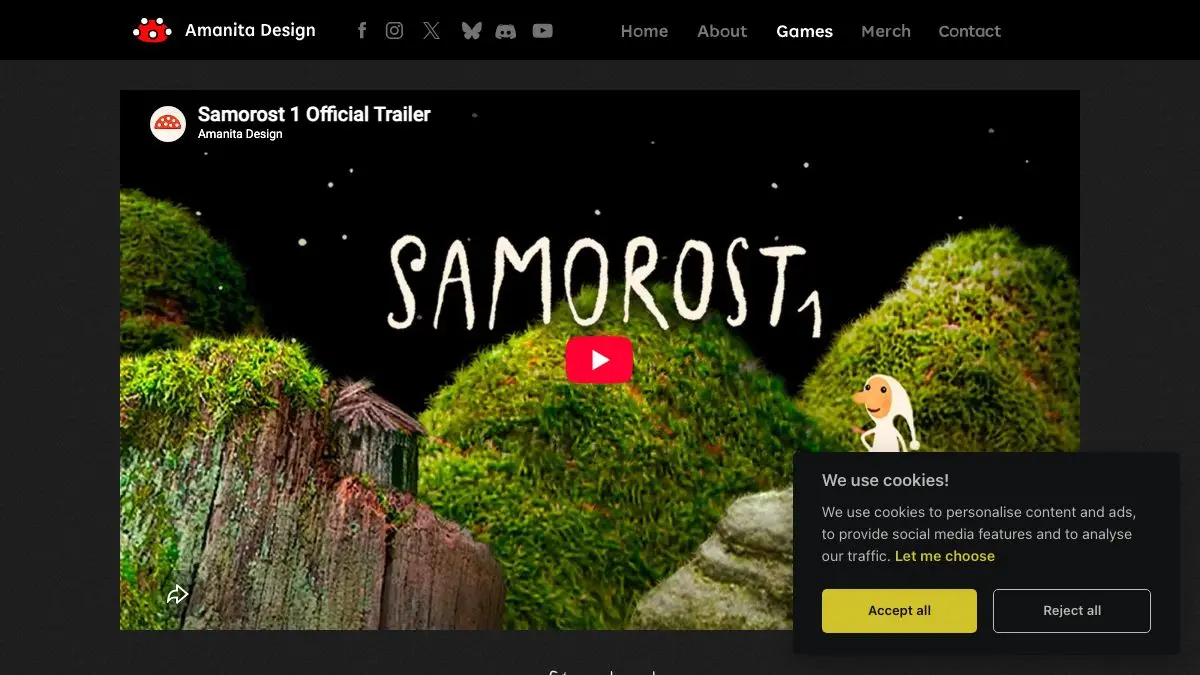
Samorost opens on a small white gnome standing on an asteroid made of tree bark, plumbing and mushrooms. Another asteroid is heading straight for it. He puts on a helmet and goes to do something about it. Nobody explains any of this, because there are no words in the entire game.
It came out in 2003, it takes about half an hour, and it is still free.
What is Samorost?
Jakub Dvorský made it as a student project at the Academy of Arts, Architecture and Design in Prague. It was built in Flash, released on the web, and quietly became one of those things everyone on the early-2000s internet eventually got sent a link to. On the strength of it he founded Amanita Design, the Czech studio that went on to make Machinarium, Botanicula, Creaks and the rest.
The look is what stops people first. Backgrounds are built from photographs of real materials, bark, rust, moss, corrugated pipe, cut up and reassembled into environments that feel simultaneously organic and mechanical. Nothing is drawn in the usual sense. It gives the world a texture that no amount of illustration would have produced, and it is the reason a game from 2003 has not visibly aged.
The design is equally unusual. There is no inventory, no cursor that changes to tell you what is clickable, no hint system, no words at all. Each screen is a small self-contained machine. You click things, they respond, and the correct sequence advances you to the next screen. You are not solving puzzles so much as figuring out what the scenery is for.
That makes it occasionally opaque and consistently delightful. Progress usually comes from clicking something that looked purely decorative and discovering it was a lever. Because there is no text, there is no language barrier and no tutorial: whatever you understand about this world, you worked out by poking it.
The sound deserves its own mention. The score and effects, by Tomáš Dvořák, are as much of the atmosphere as the visuals. Playing it muted removes roughly half the game.
Two sequels followed, and the studio’s later work is bigger and more polished in every technical sense. But the first one has a rough, homemade quality that the sequels traded away, and it remains the purest version of the idea.
What can you do with Samorost?
- Play it free in a browser. No install, no account, no plugin. It loads on Amanita’s own site.
- Click on everything. There is no highlighting of interactive objects, so exploration is the entire mechanic.
- Solve without reading. The game has no text, which means no instructions and no translation, in any language.
- Listen properly. The soundtrack and ambient effects carry a large share of the mood and occasionally the puzzle logic.
- Finish it in one sitting. It is short by design and works best uninterrupted.
- Use it as a gateway. If it lands, the studio’s later games are the natural next step, starting with Samorost 2.
Tips to get the most out of it
Wear headphones. This is not optional advice. The audio design does an enormous amount of work, and some interactions are easier to understand by ear than by eye.
Click slowly and watch the animation finish. Things react on a delay, and clicking impatiently through a screen will hide the response that tells you what just happened.
Sweep the whole screen. When stuck, move across the scene methodically rather than clicking the object that looks most important. The solution is regularly something in the background you dismissed.
Do not look for logic, look for mechanism. The puzzles are not riddles. They are contraptions. Ask what this thing physically does rather than what it means.
Give it your full attention for thirty minutes. It is short enough that half-playing it while doing something else genuinely wastes it.
Play it on a decent screen. The detail in those photographic backgrounds is the point, and a phone flattens it.
If you like Samorost, also try…
- Nice Game Hints: graded hints for exactly this kind of game, when clicking everything stops working.
- Candy Box 2: another free browser game that hides real depth behind a modest surface.
- Zoomquilt: an infinitely zooming painting with a similar handmade, dreamlike density.
- Bitey Castle: a survivor of the same Flash-era web, still running its original animations.
More things to play in Entertainment & Fun, and more beautiful work in Design & Creativity.
Frequently asked questions
What is Samorost?
Samorost is a short point-and-click adventure game about a small gnome who leaves his tiny asteroid to stop another one from colliding with it. There is no text and no dialogue; you solve everything by clicking on the scenery and watching what happens. It was made by Jakub Dvorsky as a student project and became the first game from the studio Amanita Design.
Is Samorost free to play?
Yes, the original Samorost is free to play in a browser on Amanita Design's own site. The later games in the series and the studio's other titles are commercial releases, but the first one has stayed free since it was published.
How long does Samorost take to finish?
It is short, generally somewhere in the range of half an hour for most players, and it is meant to be played in one sitting. The brevity is deliberate; it was made as a student piece rather than a full commercial release.
Does Samorost still work now that Flash is gone?
Yes. It was originally built in Flash, but Amanita Design has kept it playable in modern browsers, so you can still run it without plugins. It looks and plays essentially as it did when it was released.