// 2026-08-17 · Data & Research · by Bob Smith
OpenAlex: The Free, Open Index of 324 Million Scholarly Works
OpenAlex maps the entire research system — papers, authors, institutions, funders, journals — as one openly licensed graph, free to search in the browser and free to download in full. Built by the nonprofit behind Unpaywall.
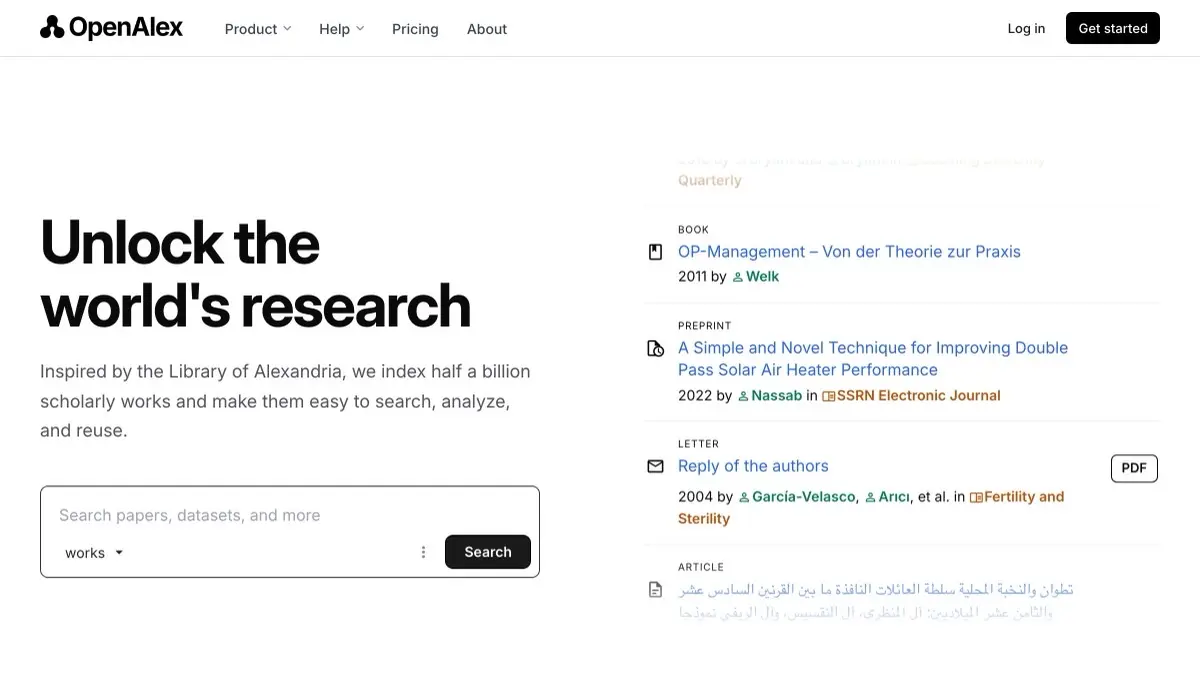
OpenAlex is trying to do something faintly absurd: catalogue all of human scholarship, link every piece of it to every other piece, and give the whole thing away.
The homepage puts it plainly — inspired by the Library of Alexandria, indexing the world’s research. Behind the search box sits a graph of 324 million works joined to 125.7 million authors, 255,000 journals and repositories, 134,000 institutions, 45,600 funders and 4,516 research topics. Ask it which universities publish most on antimicrobial resistance, or how much of a funder’s output is open access, and it will answer in a couple of clicks.
The remarkable part is not the size. It is the licence.
What is OpenAlex?
OpenAlex is run by OurResearch, a nonprofit founded in 2011 by Jason Priem and Heather Piwowar — the same pair behind Unpaywall, the tool that finds legal free copies of paywalled papers. It exists because of a specific emergency.
In May 2021 Microsoft announced the end of Microsoft Academic Graph, the free citation database a great deal of bibliometric research quietly depended on. Losing it meant the map of science would belong entirely to Web of Science and Scopus, subscription products priced for well-funded universities. OurResearch announced a replacement, released a full data dump in November 2021 so people could test their import pipelines, and launched OpenAlex on 1 January 2022, deliberately built to be backwards-compatible with MAG.
Everything is open in the way that word is supposed to mean. The metadata is CC0 — public domain, no attribution required, commercial use fine. The complete snapshot is free to download, which is the detail that separates OpenAlex from every commercial competitor: you can put the whole research graph on your own machine and compute over it. The website and snapshot remain free; only heavy programmatic use of the hosted API carries a cost, since February 2026, with $1 of free API usage per account per day before anything is charged.
The data model is a graph, not a list. A work links to its authors, their institutions, the source that published it, the funders that paid for it, its topics, its references and its citations. Every entity has its own page, so you can start at a paper and walk outwards to a lab, a funder or an entire field.
What can you do with OpenAlex?
- Search 324 million works — journal articles, preprints, books, book chapters, datasets, dissertations — without a login or a paywall.
- Profile an institution. Open a university’s page and see output over time, top topics, collaborating institutions and the share of its work that is open access.
- Follow the money. Funder entities connect grants to published output, which is how you answer “what did this funding programme actually produce”.
- Map a field. Group and filter works by topic, year, country or source to get the shape of a research area rather than a list of ten papers.
- Track open access. Every work carries its OA status and best available free location, inherited from the Unpaywall work that OurResearch has been doing since 2016.
- Download the entire dataset. The full snapshot is free and CC0, which is why OpenAlex now underpins a long list of other tools and dashboards.
- Build on the API. A documented REST API covering every entity type, with a free daily allowance and pay-as-you-go beyond it.
- Correct the record. Errors can be reported and author profiles claimed, so the disambiguation improves rather than staying wrong forever.
Tips to get the most out of it
- Search by entity type, not just keywords. The dropdown next to the search box switches between works, authors, sources, institutions and topics. Most people who find OpenAlex disappointing were searching works when they wanted institutions.
- Use the group-by view. Grouping a result set by year, country, institution or OA status turns a search into an analysis, and it is the fastest way to get a chart out of the site without writing code.
- Spot-check author profiles. Automated disambiguation is genuinely hard, and common names get merged or split. Verify before citing anyone’s publication count in something that matters.
- Look up a paper by DOI directly. Appending a DOI to the works URL jumps straight to the record, which is faster than searching the title.
- Treat coverage as uneven. Non-English work, humanities, books and regional journals are indexed better than in Scopus but still less completely than mainstream STEM journals. Say so if you publish numbers.
- Grab the snapshot if you are doing anything serious. For repeated large-scale analysis, downloading the CC0 dump is both faster and cheaper than hammering the hosted API.
- Pair it with Unpaywall. OpenAlex tells you what exists and how it connects; Unpaywall gets you a legal copy of the paper itself.
If you like OpenAlex, also try…
- Semantic Scholar: the AI-assisted research search engine, strong on extracted citation context and TLDR summaries of individual papers.
- Connected Papers: drop in one paper and get a visual graph of its neighbourhood, which is the fastest way into an unfamiliar field.
- Our World in Data: what happens when researchers stop indexing the literature and start explaining it, chart by chart, with the data attached.
- WorldCat: the equivalent catalogue for the physical world — which library near you actually holds the book.
Browse more things worth bookmarking in our Data & Research collection.
Frequently asked questions
What is OpenAlex?
OpenAlex is a free, open index of the global research system: scholarly works and the authors, institutions, journals, publishers, funders and topics connected to them. As of August 2026 its API reports 324 million works, 125.7 million authors, 255,000 sources, 134,000 institutions, 45,600 funders, 10,700 publishers and 4,516 topics. It is built and maintained by OurResearch, the nonprofit founded in 2011 by Jason Priem and Heather Piwowar that also runs Unpaywall, and it is named after the Library of Alexandria.
Is OpenAlex free, and do I need an account?
Searching and browsing on the website is free with no account. The metadata is released under CC0, meaning public domain — you can copy, redistribute and build commercial products on it with no permission needed — and the complete data snapshot is free to download. The API changed in February 2026: it now requires a key, and each account gets $1 of API usage per day for free with no payment method on file, after which you can buy prepaid credit in $1 increments or take an annual plan starting at $5,000 for institutions with heavy needs. Typical human-scale use of the website costs nothing.
Why does OpenAlex exist?
Microsoft announced in May 2021 that it was discontinuing Microsoft Academic Graph, which at the time was the main free, comprehensive citation database. Its shutdown would have left the field to Web of Science and Scopus, both expensive subscription products, meaning that basic questions about who publishes what and who cites whom could only be answered by institutions that could pay. OurResearch built OpenAlex as a deliberately backwards-compatible replacement, funded with support from the Arcadia Fund, and launched it on 1 January 2022 — the day after MAG went dark.
How does it compare to Google Scholar, Scopus or Web of Science?
OpenAlex is broader than Scopus and Web of Science in raw coverage and it is the only one of the four whose entire dataset you can download and redistribute. What you trade for that is curation: automated author disambiguation produces merged and split author profiles, institutional affiliations can be wrong, and coverage quality varies by discipline and language. Google Scholar is wider still in some corners but has no bulk export, no stable API and no open licence, so you cannot compute over it. The practical rule is that OpenAlex is best when you need the whole graph rather than one perfect record — bibliometrics, mapping a field, tracking open access — and that any single author or institution profile should be spot-checked before you quote it.