// 2026-08-10 · Music & Audio · by Bob Smith
musicForProgramming: 78 Hand-Curated Mixes Built for Deep Focus
Since 2009, Datassette has been assembling hour-long ambient mixtapes designed to hold your attention loosely while you work. No account, no ads, no algorithm — just a numbered list.
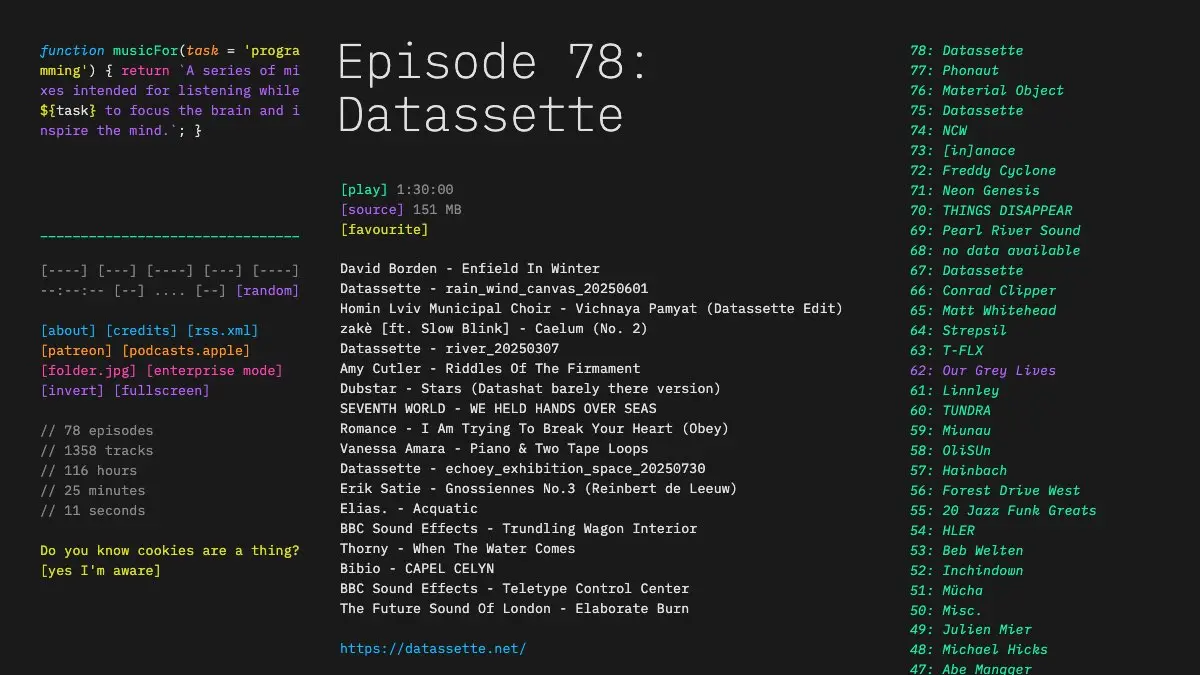
musicForProgramming is a list of 78 mixes and almost nothing else. Green monospace text on a dark page, the site’s own name written as a line of code — musicForProgramming("78: Datassette"); — and underneath it every episode going back to 2009, newest first.
It has survived seventeen years without a redesign, a recommendation engine, or a sign-up prompt, which in 2026 counts as a design philosophy.
What is musicForProgramming?
It is a mixtape series started by Datassette, a UK electronic producer, on the premise that the music you work to has a specific job: to fill the room without asking for anything. The site’s own phrasing is music that can engulf the listener while being fully appreciated with only peripheral attention paid to it. That constraint is what separates it from a generic “focus” playlist — every episode is sequenced by a person who knew you would be reading something else while it played.
Roughly a third of the episodes are compiled by Datassette. The rest are guest mixes, and the guest list is a decent map of the last two decades of thoughtful electronic music: Com Truise, Hainbach, Konx Om Pax, Forest Drive West, Jo Johnson, Lackluster, TUNDRA, 20 Jazz Funk Greats, and dozens more. Every episode carries a full tracklist, which turns each one into a reading list as much as a listen.
The pace is slow on purpose. Episodes appear a few times a year, not weekly. Episode 78 landed in April 2026 and runs an hour and a half. The site keeps a running tally in the sidebar, which currently reads 78 episodes, 1,358 tracks, 116 hours and change — seventeen years of listening, counted to the second.
What can you do on musicForProgramming?
- Press play and stop deciding. Each episode is one continuous mix of 60 to 90 minutes. No shuffle, no skip-fatigue, no algorithm nudging you toward something with a chorus.
- Read the tracklist. Every episode lists what is in it, so the thing you noticed at minute 40 is findable rather than lost.
- Download the MP3s. The audio files are direct links. Keep them locally and the mixes work on a plane, in a basement, or in ten years when the site is gone.
- Subscribe by RSS. The feed is a proper podcast feed — paste it into any podcast app and the archive arrives with it.
- Dig back through the guest curators, which is the best way to use the archive: find an episode you like, look up who made it, and follow that thread outward.
- Support it if you want to. There is a Patreon. There is no nag, no interstitial, and no difference in what you get if you ignore it.
- Browse the mirror. The full series is archived on the Internet Archive, so the catalogue outlives the domain.
Tips to get the most out of it
- Start at the newest and work backwards. The early episodes are more beat-driven and the recent ones drift further into ambient and field recording. Both are good; the recent ones are the better first taste of what the series is now.
- Try a Datassette-compiled episode first. Episodes 1, 9, 31, 42, 67, 75 and 78 are his own, and they define the house style the guests are riffing on.
- Download rather than stream for real work sessions. A dropped connection halfway through a mix is a bigger interruption than a notification.
- Use the tracklist as a discovery engine. Half the value of this site is not the mixes but the several hundred artists they quietly introduce you to.
- Give it the full 90 minutes. These are sequenced arcs, not playlists. Judging one from three minutes is like judging a book from its second paragraph.
- Bookmark the RSS feed instead of the homepage. Episodes are irregular enough that checking manually means you either check too often or miss a year.
If you like musicForProgramming, also try…
- A Soft Murmur: when you want rain and hum rather than music, mixed to your own taste.
- Lofi ATC: beats under live air traffic control chatter, which scratches a very similar itch from an odder angle.
- JazzRadio: human-programmed channels for when the ambient thing gets too weightless.
- Radio Garden: spin the globe and land in someone else’s local station, for the days focus is not the point.
Find more listening in our Music & Audio collection.
Frequently asked questions
What is musicForProgramming?
musicForProgramming is a long-running series of curated ambient and electronic mixes intended for listening while you concentrate. It was started in 2009 by the UK producer Datassette and now runs to 78 episodes, each roughly an hour to ninety minutes long, each with a full tracklist. Some episodes are compiled by Datassette; many are guest mixes from artists including Com Truise, Hainbach, Konx Om Pax, Forest Drive West and Lackluster. The site itself is a single page of green monospace text, presented as a function call.
Is musicForProgramming free? Do I need an account?
It is free and there is no account, no signup, no email capture and no paywall. Every episode streams directly in the browser and the underlying MP3 files are plain links you can download and keep. The project is supported by an optional Patreon rather than by advertising, and the whole archive is also mirrored on the Internet Archive, which is about as durable as a music site gets.
Can I subscribe to musicForProgramming in a podcast app?
Yes. The site publishes an RSS feed at musicforprogramming.net/rss.xml with proper podcast tags, so you can paste that URL into any podcast client and get every episode plus each new one as it appears. New episodes arrive irregularly — a handful a year rather than weekly — so subscribing is a better fit than checking back.
What kind of music is on it, and does it actually help you concentrate?
The palette is ambient, dub techno, drone, downtempo electronica, tape loops, field recordings and the occasional piece of modern classical. The stated aim is music that can engulf you but survives only peripheral attention, which in practice means very few vocals, few abrupt transitions, and nothing that demands a reaction. Whether it helps is personal — instrumental music with a steady texture is a common preference for concentration work — but the useful property here is that a mix is 90 minutes of continuous listening with no decisions in it, which is exactly what a playlist and a shuffle button fail to give you.