// 2026-08-05 · Learning & Education · by Bob Smith
Flag Match: Learn Every Country's Flag by Playing Concentration
Flag Match is a free timed matching game that pairs world flags with country names. Play a few rounds a day and you will actually learn all 236 of them.
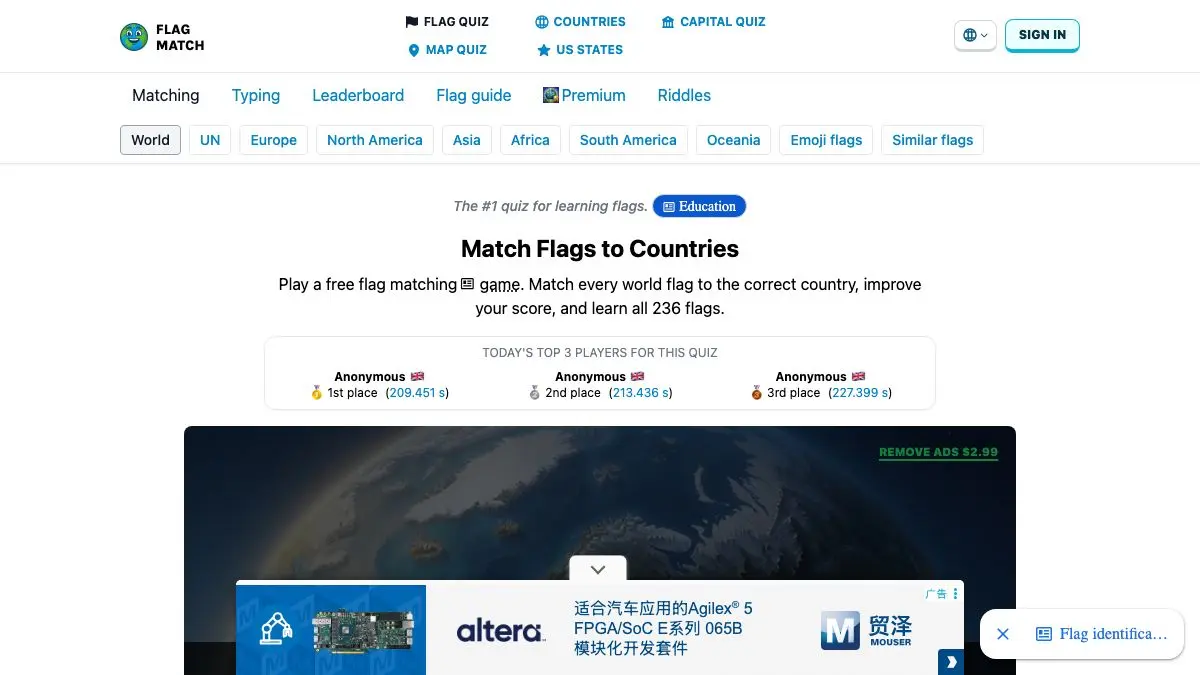
Flag Match is a memory game with a hidden agenda. On the surface it is Concentration: tiles of flags on one side, country names on the other, tap two that go together, beat the clock. Underneath, it is a spaced-repetition drill that will quietly install all 236 world flags into your head while you think you are just killing five minutes.
The moment you realize it is working is when you spot Chad on a news broadcast and know, with irritating confidence, that it is not Romania.
What is Flag Match?
The core game gives you a grid of flags and a grid of country names, ten at a time. You select one from each side; correct pairs vanish and add to your score, wrong pairs cost you time from the clock. Chain correct answers and your streak counter climbs. Sit there staring too long and the game takes pity and shows a hint.
That penalty-and-streak structure is why it works. A plain flag quiz lets you deliberate. A timer punishes deliberation, which forces recall rather than reasoning, which is exactly the mode in which things get memorized.
The catalogue is split into decks so you are never facing the whole world at once. There are regional sets for Europe, Africa, Asia, North America, South America and Oceania, a UN members deck, and two themed sets that are more interesting than they sound: emoji flags, which uses the tiny versions your phone renders, and similar flags, which throws only the confusable ones at you. That last deck is the one that turns a casual player into someone who can tell Chad from Romania, Monaco from Indonesia, and Ireland from Ivory Coast without thinking.
Matching is not the only mode. There is a typing mode where you see a flag and spell the country name, which is considerably harder and much better at exposing the countries you only recognize rather than know. There is also a riddles section, a flag guide for reference reading, and a leaderboard if you want the competitive pressure.
The site does not stop at flags either. Country, capital, map and US states quizzes use the same engine, which means the muscle memory transfers straight across. The interface ships in several languages, so it works as a geography drill in Spanish or Japanese too.
What can you do with Flag Match?
- Play the world deck. All 236 flags, ten pairs at a time, against the clock. This is the default and the main event.
- Drill one region. Europe or Africa alone is far less overwhelming and much better for actually building coverage.
- Attack the similar flags deck. The Nordic crosses, the pan-African tricolors, the near-identical Slavic ones. This deck is where most of your remaining errors live.
- Switch to typing mode. Recognition and recall are different skills. Typing tests the harder one.
- Take the capital and map quizzes. Same format, different geography, and they reinforce each other.
- Read the flag guide. Useful for the ones you keep missing, especially when the difference is a coat of arms or a shade of blue.
- Chase the leaderboard. Sign in and your times get ranked, which is either motivating or unbearable depending on temperament.
Tips to get the most out of it
Play short and often. Three rounds a day beats an hour on a Sunday. The whole design rewards repeated brief exposure, and cramming a flag quiz has roughly the retention of cramming anything else.
Do regions before the world. Starting on all 236 mostly teaches you frustration. Learn Europe cold, then Africa, then stack them.
Live in the similar flags deck. Your score on the world deck is limited almost entirely by about twenty confusable pairs. Fixing those is the highest-value hour you can spend on the site.
Say the country name out loud. It sounds daft and it measurably helps. Linking the visual to a spoken word gives you a second retrieval path.
Move to typing once matching feels easy. Matching lets you eliminate by process; typing does not. If you can spell it from the flag, you know it.
Do not rush the hint. Waiting the extra second and failing to recall is more useful for learning than being handed the answer, even though it costs you clock time.
If you like Flag Match, also try…
- JetPunk: thousands of user-made quizzes, with a very deep geography section.
- Geotastic: guess where in the world you are from a Street View drop, flags included.
- The True Size Of: drag countries around a map and discover the Mercator projection has been lying to you.
- Freerice: another quiz drill built around short repeated rounds, with a charitable twist.
More painless drilling in Learning & Education, and the geography rabbit hole continues in Maps & Exploration.
Frequently asked questions
What is Flag Match?
Flag Match is a browser game where you pair flags with the correct country names against a timer. It covers all 236 world flags, split into regional decks such as Europe, Africa and Asia, plus themed sets like similar-looking flags and emoji flags. There is also a typing mode where you spell the country name instead of matching a tile.
Is Flag Match free?
Yes, the games are free to play in a browser with no account. The site is ad-supported and offers a paid ad-free option, and signing in is only needed if you want your scores on the leaderboard.
Does Flag Match have quizzes other than flags?
Yes. Alongside the flag games there are country, capital city, map and US states quizzes, so the same format covers most of school geography. The interface is available in several languages including Spanish, German, French, Portuguese and Japanese.
How long does it take to learn all the flags?
That depends on you, but the format is built for short repeated sessions rather than one long grind. Most people find the regional decks stick within a few weeks of daily play, with the lookalike flags taking the longest.