// 2026-08-05 · Entertainment & Fun · by Bob Smith
Cleverbot: The Chatbot That Blew Everyone's Mind Before LLMs
Cleverbot has been holding strange, circular conversations with the internet since 1997, learning every reply from the humans who talked to it. It still works.
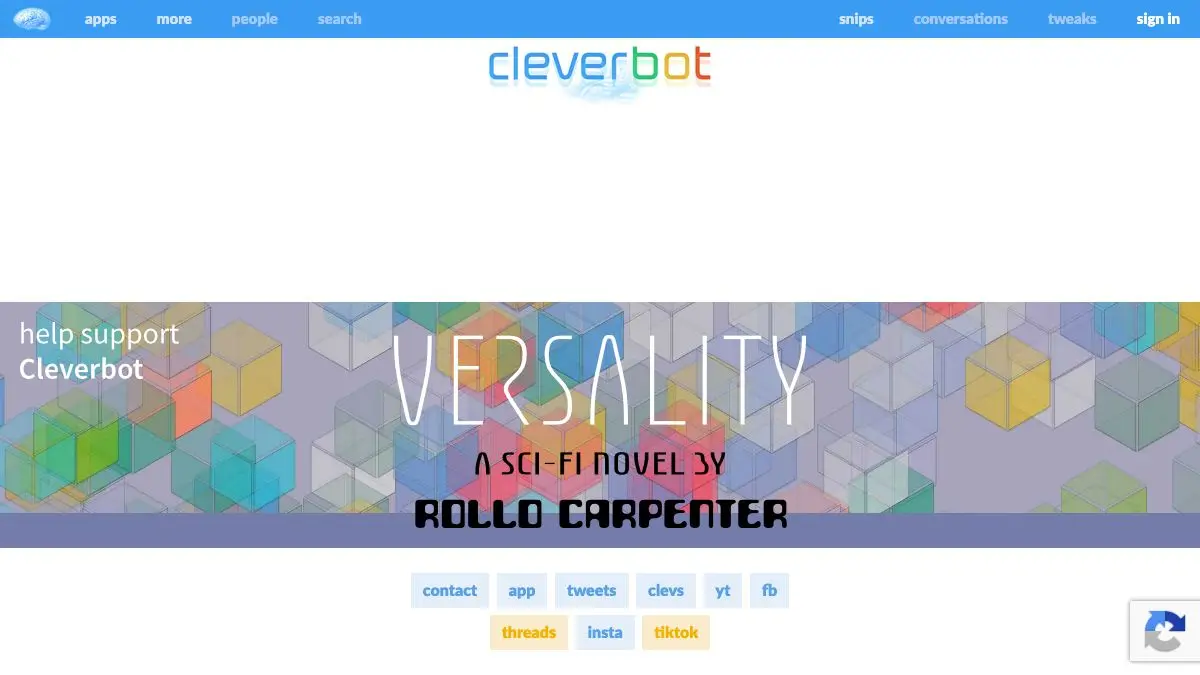
Cleverbot is a plain text box on a plain page, and for a long stretch of internet history it was the most unsettling thing you could open in a browser. You typed something. It typed back. Not well, exactly, but well enough that you kept going, and then it said something that landed too precisely and you sat back from the keyboard.
It is still there. It still does it.
What is Cleverbot?
Cleverbot is the work of British programmer Rollo Carpenter, who had been building conversational software since the 1980s under the name Jabberwacky. Cleverbot went online in 1997 and has been talking to strangers continuously ever since, which makes it older than most of the people currently talking to it.
The trick is that it does not compose anything. Modern chatbots generate language from a model trained to predict text. Cleverbot does something almost primitive by comparison: it keeps an enormous log of everything humans have ever said to it, and when you type a line, it finds a similar exchange in that archive and replies with what a real person said next. Every reply is second-hand. Every reply was once typed by a human being who thought they were talking to a machine.
That design gives it a particular flavor of weirdness. It has no memory of you, no consistent personality, and no idea what it is. It will insist it is human. Pressed, it will accuse you of being the robot. It will announce that it is a cat, or from France, or nineteen years old, and mean all of it equally. Ask it the same question twice and get two answers that cannot both be true.
It also produced one of the strangest results in the history of conversational software. At a 2011 technology festival in Guwahati, India, a large-scale Turing-style test had volunteers rate Cleverbot and human participants, and Cleverbot was judged human by a surprisingly large share of voters, high enough to make headlines worldwide. The methodology was informal and the number should not be taken as a serious Turing test result, but it captured something real: a retrieval system replaying human sentences can be convincing precisely because the sentences were human to begin with.
There is a whole genre of internet culture built on top of it, including the classic exercise of putting two Cleverbot instances in conversation with each other and watching the dialogue spiral into accusations, marriage proposals and theology within twenty exchanges.
Coming to it now, after LLMs, is a genuinely useful experience. It shows you how much of the illusion of conversation was always projection on our side.
What can you do with Cleverbot?
- Just talk to it. No account, no setup. Type into the box and it answers. That is the whole product.
- Try to catch it out. Ask what you said two messages ago. Ask it to do arithmetic. The seams show fast, and watching where they show is the interesting part.
- Ask it what it is. The answers are inconsistent, confident and different every session.
- Feed it nonsense. Because replies are retrieved rather than generated, absurd input produces absurd but recognizably human output rather than a polite refusal.
- Compare it to a modern chatbot. Run the same five prompts through Cleverbot and an LLM. The contrast is the fastest lesson in what changed.
- Loop it against itself. Open two tabs, paste each reply into the other. It escalates.
Tips to get the most out of it
Do not expect memory. It carries almost nothing between messages. Long conversations do not build, they drift, and the drift is where the entertainment lives.
Short lines work better than paragraphs. Retrieval matching does best on the kind of thing people actually type at chatbots. A carefully structured multi-part question will get a reply meant for something else entirely.
Remember a human wrote the reply. When it says something startling, someone typed that sentence at Cleverbot once, probably years ago. That framing makes the whole experience considerably eerier.
Treat it as a historical artifact. Judged against a modern assistant it fails immediately. Judged as a 1997 web toy still running unchanged, it is remarkable.
Do not tell it anything private. Conversations feed the archive that generates future replies. This is the entire mechanism, so behave accordingly.
If you like Cleverbot, also try…
- This Person Does Not Exist: the same uncanny feeling, delivered through faces instead of sentences.
- Gizoogle: another survivor from the era when a single text-mangling gimmick could take over the web.
- Zombo.com: proof that some websites from the late nineties simply refuse to end.
- The Useless Web: a random door into everything else the internet built for no reason.
More surviving relics and time sinks in Entertainment & Fun and Weird & Wonderful.
Frequently asked questions
What is Cleverbot?
Cleverbot is a web-based chatbot created by British programmer Rollo Carpenter, launched online in 1997 and built on his earlier Jabberwacky project from the 1980s. Instead of generating language from a trained model, it searches its archive of past human conversations and replies with something a real person once said in a similar context. Every conversation it has feeds back into that archive.
Is Cleverbot free?
Yes, you can chat with Cleverbot for free on the website without creating an account. There have been paid apps and a developer API over the years, but the browser version has always been open to anyone.
Is Cleverbot an AI like ChatGPT?
Not in the same sense. Modern chatbots are large language models that generate text token by token from learned statistical patterns. Cleverbot works by retrieval: it matches your input against a huge log of previous conversations and returns a human-written reply from that log. The result feels uncanny in a completely different way.
Why does Cleverbot say strange or contradictory things?
Because its replies are borrowed from thousands of different people, it has no consistent identity, memory or opinions. It will claim to be human, then a robot, then a cat, sometimes within three messages. That inconsistency is a direct consequence of how it works, not a bug.